
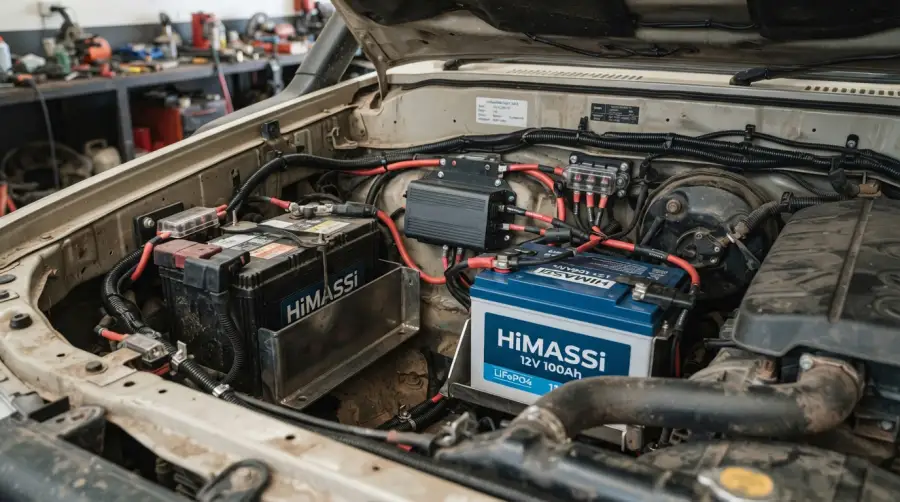
Commercial Disclosure: The HiMASSi® Editorial Team combines local Australian market insight with the battery engineering and manufacturing expertise of Shenzhen Himax Electronics Co., Ltd. to provide practical, technically informed content for businesses, OEMs, system integrators, and industry professionals. As Himax Electronics’ official flagship brand in Australia, HiMASSi® focuses on LiFePO4 batteries, custom battery solutions, BMS technology, charging systems, battery selection, and application-specific power solutions. Our content covers technical guidance, industrial and commercial applications, product updates, and HiMASSi® news. All content reflects HiMASSi®’s official editorial perspective and is intended to help Australian customers evaluate battery solutions based on their application requirements, operating conditions, system compatibility, and project needs.
Key Takeaways
- Cold temperatures can affect battery chemistry and power output. Starting batteries that are already undercharged or aging are more likely to struggle on cold mornings.
- Starting batteries, portable jump starters, and auxiliary camping batteries serve different purposes. When choosing one, evaluate starting capability, energy capacity, and output specifications separately.
- LiFePO4 batteries may have different charging and discharging temperature ranges. A battery that can discharge at low temperatures is not necessarily safe to charge at the same temperature.
- Winter backup power should be sized based on device energy consumption, operating time, conversion losses, and available recharging options—not just amp-hours or peak power.
- Before traveling to high-altitude or remote areas, or heading out on a multi-day camping trip, check the vehicle battery and charging system and reserve enough power for essential equipment such as communications and lighting.
Why Should You Pay Attention to Your Battery When Driving in Australia During Winter?
Winter driving conditions vary significantly across Australia. Daily commuting in coastal cities, early-morning driving in southern regions, and road trips to alpine snow areas can place very different demands on a vehicle battery. Whether additional preparation is needed should be based on the destination temperature, overnight parking conditions, and travel plans rather than simply the weather at the departure point.

From a battery manufacturing and application perspective, winter starting problems generally involve three factors: reduced battery output capability, increased engine cranking demand, and insufficient battery state of charge.
Low temperatures slow the chemical reactions inside lead-acid batteries, making voltage drop during engine starting more noticeable. The effect can be more pronounced if the battery is already aging or has remained partially charged for an extended period. RACV’s winter vehicle maintenance guidance also notes that cold weather can affect a car battery’s starting capability and recommends watching for signs such as slow cranking, terminal corrosion, and loose connections.
Short trips may also fail to replenish all the energy consumed during engine starting and while the vehicle is parked. Frequently driving for only a few minutes, combined with continuous loads such as dash cams and parking surveillance systems, can gradually leave the battery undercharged.
What Is the Difference Between a Starting Battery and Backup Power?
When preparing for winter road trips in Australia, first determine whether you need to solve a vehicle starting problem or a stationary power requirement.
| Power Source | Primary Purpose | Key Specifications to Check | Operating Limitations |
| Vehicle starting battery | Delivers high current for a short period to start the engine | Voltage, cold cranking amps, physical dimensions, and vehicle compatibility requirements | Not designed for repeated, prolonged deep discharge |
| Portable jump starter | Assists with vehicle starting under specified conditions | Vehicle voltage, supported engine size, operating temperature, and starting capability | Cannot repair a failed battery or charging-system fault |
| Deep-cycle auxiliary battery | Provides continuous power for refrigerators, lighting, and other equipment | Usable capacity, continuous discharge current, charging requirements, and cycle-use conditions | Standard energy-storage batteries should not be used directly as starting batteries |
| Portable power station | Powers DC, USB, or AC devices | Watt-hour capacity, continuous output power, ports, and input capability | Models not specifically designed for vehicle starting should not be used for jump-starting |
It is also important to distinguish between power and energy. Power determines what equipment a power source can operate, while energy determines how long that equipment can run. A product with a high peak output rating will not necessarily keep a portable refrigerator running longer.
What Should You Check on Your Car Battery Before a Winter Trip?
Check the Battery Case, Terminals, and Mounting
Inspect the battery for leaks, swelling, or damage to the case, as well as corrosion or looseness around the terminals. A battery that is not securely mounted may be more susceptible to connection problems and mechanical damage when driving over rough roads.
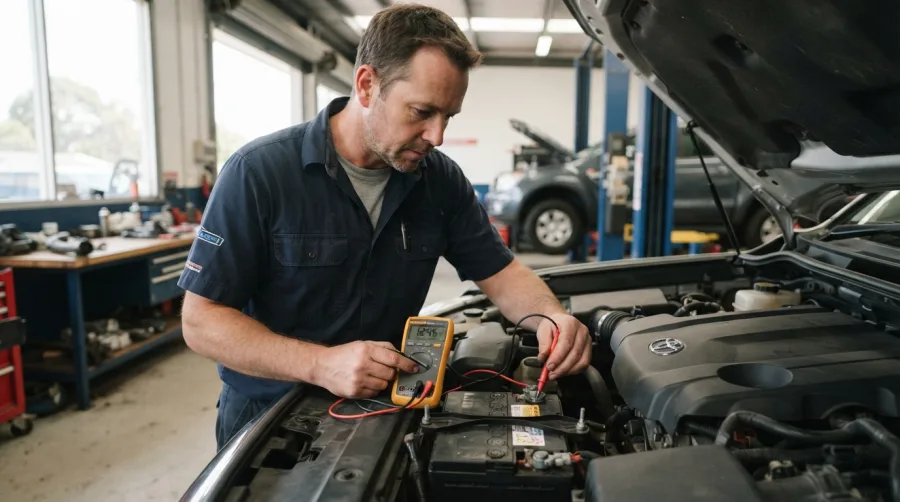
For sealed maintenance-free batteries, do not attempt to pry open the case to add water. RAC WA’s winter vehicle inspection guidance similarly emphasizes keeping terminals clean, ensuring connections are secure, and arranging professional testing when problems are identified.
Distinguish Between a Low State of Charge and an Aging Battery
A low state of charge describes the battery’s current charge level, while battery aging involves a decline in capacity and power-delivery capability. Both can result in weak engine cranking, but they require different responses.
A single open-circuit voltage measurement is not enough to fully determine battery health. Testing should consider the battery’s state of charge, temperature, cranking performance, and appropriate load or conductance test results. Repeated undercharging should also prompt checks for parasitic loads, wiring and connection issues, and problems with the vehicle charging system.
Check the Vehicle Requirements Before Replacing the Battery
Cold cranking amps, commonly expressed as CCA, describe a battery’s starting capability under specified low-temperature test conditions. CCA is not the same as Ah capacity, and the applicable test standard should also be considered when comparing CCA ratings.
Vehicles equipped with automatic start-stop systems may require EFB or AGM batteries. These battery types have different designs and intended applications and should not be substituted simply because they look similar or share the same voltage rating. Some vehicles may also require battery registration or programming after replacement, so the applicable vehicle service procedures should be followed.
How Do You Choose Backup Power for a Winter Road Trip? Start With Energy Consumption
Backup power capacity should be calculated around the equipment you actually plan to use. Compared with looking at Ah alone, Wh provides a more straightforward way to compare the energy consumption of different devices.
Device Energy Consumption (Wh) = Average Power (W) × Operating Time (h)
The following hypothetical figures illustrate the calculation:
| Device | Assumed Average Power | Operating Time | Estimated Energy Consumption |
| Portable refrigerator | 25W | 12 hours | 300Wh |
| LED lighting | 8W | 5 hours | 40Wh |
| Laptop | 45W | 2 hours | 90Wh |
| Phone and small devices | Estimated per recharge | — | 30Wh |
| Total | — | — | 460Wh |
Refrigerator energy consumption varies with ambient temperature, temperature settings, how often the door is opened, and insulation performance. The figures in the table are examples for calculation purposes and are not equipment performance claims.
If the plan assumes that 80% of the battery’s nominal energy is usable and the overall power-delivery efficiency is estimated at 90%, then:
Required Nominal Energy ≈ 460 ÷ (0.8 × 0.9) ≈ 639Wh
The 80% and 90% figures are calculation assumptions, not universal specifications. Actual battery sizing should also account for low-temperature effects, battery aging, and unexpected travel delays. If a product already provides measured usable energy at the relevant output, that figure should be used whenever possible to avoid accounting for the same losses twice.
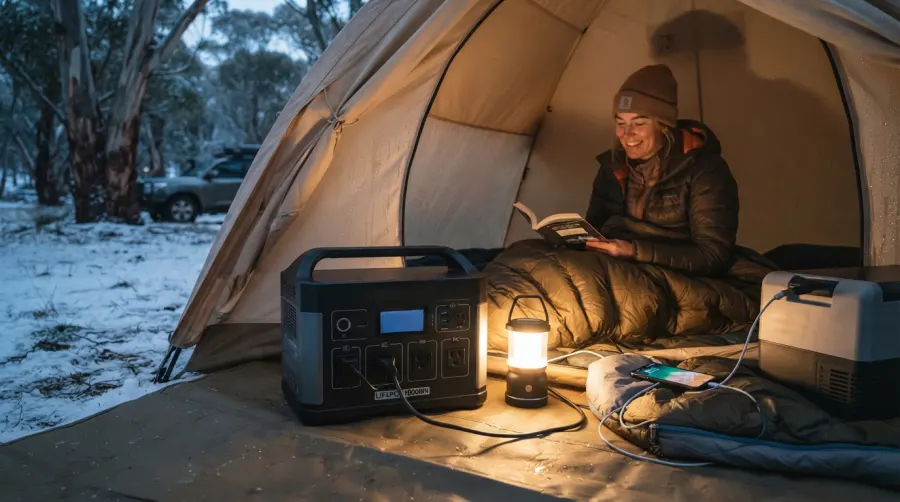
You should also check the combined power demand of devices operating at the same time, including any startup or surge requirements. Appliances such as electric kettles and space heaters can consume stored energy very quickly. The fact that a device can physically connect to the power source does not mean it is practical for extended use.
What Should You Know About Dual-Battery Systems and Solar Recharging?
In a dual-battery system, the vehicle’s starting battery handles engine starting while the auxiliary battery powers camping loads. Proper isolation and charging management can help reduce the impact of stationary power consumption on the energy reserved for starting the vehicle.
A dual-battery system should be designed around the alternator type, battery chemistry, charging current, and cable specifications. A compatible DC-DC charger can manage charging according to the auxiliary battery’s requirements, but not every charger supports every battery chemistry or alternator system. Compatibility should be checked carefully before installation.
For solar recharging in winter, consider available daylight hours, cloud cover, shading, and panel orientation. A solar panel’s rated power does not represent continuous power generation throughout the day. When planning a multi-day trip, estimate solar energy production based on conditions at the destination and have another compatible charging method available when necessary.
Frequently Asked Questions About Vehicle Batteries and Backup Power in Australian Winter
Does Difficulty Starting a Car in Winter Mean the Battery Needs to Be Replaced?
Not necessarily. A low state of charge, poor terminal connections, starter motor problems, or a charging-system fault can all affect starting performance. The battery and related systems should be tested first to determine whether recharging, repair, or replacement is appropriate.
After a Successful Jump-Start, Will a Short Drive Fully Recharge the Battery?
There is no fixed driving time that guarantees a full recharge. The time required depends on how deeply discharged the battery is, its condition, the vehicle’s charging strategy, and the electrical loads operating while driving. After a significant discharge event, the battery should be tested and, when necessary, recharged with a compatible battery charger.
How Long Can a 100Ah Battery Run a Portable Refrigerator?
You also need to know the battery voltage, usable energy, and the refrigerator’s average power consumption. For example, a 12.8V, 100Ah battery has a nominal energy capacity of approximately 1,280Wh. Assuming 80% usable energy, 90% power-delivery efficiency, and an average refrigerator load of 25W, the theoretical runtime would be approximately 36.9 hours. This result applies only to these assumptions and should not be treated as a guaranteed real-world runtime.
Does a Battery With a BMS Automatically Have Low-Temperature Charging Protection?
No. BMS functionality varies by battery design. Check whether the battery specifications explicitly include low-temperature charge cutoff, temperature sensing, and recovery conditions rather than assuming these features are included based on descriptions such as “smart BMS.”
About HiMASSi®
HiMASSi is the official flagship brand of Shenzhen Himax Electronics Co., Ltd. for the Australian market. From a battery manufacturing and application-matching perspective, we focus on practical requirements for vehicle backup power, outdoor travel, and energy-storage applications, with particular attention to matching capacity, output capability, temperature conditions, and charging systems. Explore HiMASSi products and review the technical specifications of individual models based on your vehicle configuration, equipment energy consumption, and winter travel plans to build a power solution suited to your trip.