

Commercial Disclosure: The HiMASSi® Editorial Team combines local Australian market insight with the battery engineering and manufacturing expertise of Shenzhen Himax Electronics Co., Ltd. to provide practical, technically informed content for businesses, OEMs, system integrators, and industry professionals. As Himax Electronics’ official flagship brand in Australia, HiMASSi® focuses on LiFePO4 batteries, custom battery solutions, BMS technology, charging systems, battery selection, and application-specific power solutions. Our content covers technical guidance, industrial and commercial applications, product updates, and HiMASSi® news. All content reflects HiMASSi®’s official editorial perspective and is intended to help Australian customers evaluate battery solutions based on their application requirements, operating conditions, system compatibility, and project needs.
Key Takeaways
- Truck battery selection should be based on the vehicle owner’s manual, original battery label, and electrical system specifications rather than physical dimensions alone.
- 12V and 24V systems use different voltage architectures. A 24V truck commonly uses two 12V batteries connected in series, and paired batteries should ideally have similar specifications, production batches, and ageing conditions.
- CCA helps evaluate cold-weather starting capability, RC indicates backup time under a specified current load, and Ah is more useful when evaluating auxiliary power and cycling applications.
- Starting batteries and auxiliary batteries are designed for different purposes. Repeated deep discharges can accelerate performance degradation in conventional starting batteries.
- High temperatures, low temperatures, vibration, terminal corrosion, prolonged undercharging, and charging-system faults can all affect truck battery life and starting performance.
- After replacing a battery, check alternator charging voltage, ground connections, terminal tightness, and auxiliary equipment power consumption to avoid mistaking a system fault for a battery problem.
- If a battery shows swelling, leakage, a cracked case, unusual odors, severe terminal corrosion, or abnormal heating, stop using it and have it inspected by a qualified professional.
Introduction
A truck battery may appear to be little more than a starting component, but in practice it supports engine starting, lighting, parking air conditioning, onboard refrigerators, liftgates, communication equipment, and overall fleet operations. Choosing the right truck battery requires more than checking voltage and physical size. Engine displacement, cold-starting requirements, parking power consumption, alternator capability, road vibration, and electrical modifications should also be considered.
For truck operators in Australia, long-distance transport, high-temperature exposure, limited access to services in remote areas, and overnight parking loads can all affect battery operating conditions. From a battery manufacturing and application-integration perspective, this guide explains how to choose truck starting batteries, auxiliary batteries, and lithium battery systems, along with practical inspection and maintenance considerations.
What Type of Battery Does a Truck Need?
Lead-acid starting batteries remain common in conventional diesel and gasoline trucks. Their primary function is to deliver high current for a short period to crank the engine.
For trucks equipped with parking air conditioning, onboard refrigerators, inverters, work lights, communication terminals, or liftgates, relying on the starting battery to support all electrical loads may reduce the energy available for the next engine start.
Battery selection should therefore begin by identifying the role each battery is expected to perform.
| Battery Type or System Role | Common Applications | Key Selection Factors | Usage Considerations |
| Starting battery (SLI) | Engine starting and basic vehicle electrical systems | Voltage, CCA, dimensions, terminal position, mounting method | Not designed for repeated deep discharge |
| Auxiliary battery | Parking air conditioning, refrigerators, lighting, communication equipment | Ah, usable energy, cycle capability, charging method | Consider isolation from the starting battery or a DC-DC charging strategy |
| AGM battery | Frequent start-stop operation, higher electrical loads, some heavy-duty applications | Charging-voltage compatibility, installation space, vibration resistance | Avoid replacing with a conventional battery unless permitted by the vehicle manufacturer |
| EFB battery | Some vehicles with start-stop systems or higher cycling requirements | Original vehicle technology, charging characteristics, cycling requirements | Verify against the vehicle manufacturer’s requirements |
| Deep-cycle lead-acid battery | Camper-truck conversions, parking loads, auxiliary equipment | Cycle life, depth of discharge, charging profile | Designed around different priorities than a starting battery |
| LiFePO4 auxiliary battery system | Extended parking power, weight reduction, customized power systems | BMS, low-temperature charging limits, DC-DC charging, fuses, and wiring | Complete system design and installation should be carried out by experienced personnel |
If a truck uses a 24V starting system, a common configuration consists of two 12V batteries connected in series. In a series connection, voltage is added while amp-hour capacity remains the same. For example, two 12V 100Ah batteries connected in series form a 24V 100Ah system.
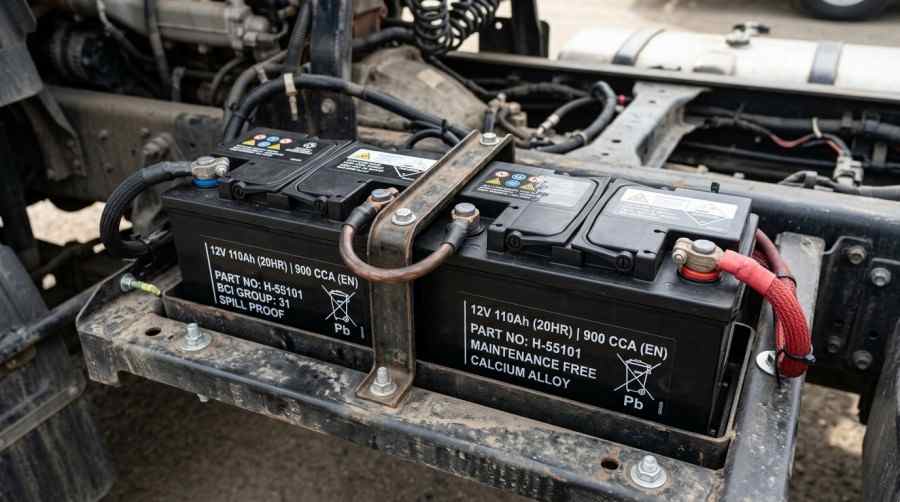
If only one ageing battery in such a system is replaced, differences in capacity, internal resistance, and charge acceptance between the new and old batteries may increase imbalance over time. A more reliable approach is to follow the vehicle manufacturer’s requirements and evaluate paired batteries for matching specifications and condition.
Understanding Truck Battery Labels: What Do CCA, RC, and Ah Mean?
Battery labels contain several specifications, but CCA, RC, Ah, rated voltage, physical dimensions, and terminal layout are among the most important for truck applications.
According to Battery Council International, CCA refers to the discharge current a new, fully charged and conditioned battery can deliver for 30 seconds at -18°C while maintaining a specified terminal voltage. RC refers to the number of minutes a battery can discharge at 25A at 26.7°C before reaching a specified end voltage. These ratings represent different performance characteristics and should not be treated as interchangeable. Battery Council International Battery Terms
| Parameter | What It Indicates | Why It Matters for Trucks | Common Misunderstanding |
| Rated voltage (V) | Battery system voltage platform | Must match the vehicle’s 12V or 24V system | Similar appearance does not mean batteries with different voltages are interchangeable |
| CCA | Short-duration cold-starting capability | Particularly important for cold climates, large engines, and high starting loads | Choosing the highest CCA while ignoring dimensions and charging-system compatibility |
| RC | Backup duration under a specified load | Helps indicate how long the battery may support basic electrical loads | Treating RC as the exact runtime for all onboard equipment |
| Ah | Amount of electrical charge stored | Useful for auxiliary batteries, deep-cycle applications, and energy planning | Ignoring discharge rate, temperature, and cutoff-voltage effects |
| Dimensions and base | Installation space and mounting structure | Determines whether the battery can be securely installed | Measuring only length, width, and height while ignoring hold-down features |
| Terminal layout and polarity | Positive and negative terminal positions and terminal type | Affects cable routing and short-circuit risk | Stretching or crossing original vehicle cables to make them fit |
CCA does not represent everyday usable energy. For trucks running an inverter, lighting, or refrigerator for extended periods while parked, auxiliary battery cycle capability, usable Ah, recharge rate, and battery-isolation strategy can be equally important.
Conversely, a deep-cycle battery with a high capacity may not necessarily be suitable as a direct replacement for a high-current starting battery.
How to Choose a Truck Starting Battery
Start With the Vehicle Manual and Original Battery Specifications
Check the owner’s manual, original battery label, or dealer parts catalogue to confirm:
- Whether the vehicle uses a 12V or 24V electrical system;
- The number of original batteries, series/parallel configuration, and installation location;
- Original CCA, Ah, or RC specifications;
- Battery dimensions, base hold-down design, and terminal positions;
- Whether the vehicle has a start-stop system, smart charging system, or battery sensor;
- Whether additional loads such as parking air conditioning, a liftgate, inverter, or onboard refrigerator are installed.
If the vehicle uses a smart alternator or battery monitoring sensor, battery replacement may require matching, resetting, or registration according to the vehicle manufacturer’s procedure. Whether this is necessary depends on the specific vehicle and control strategy.
Choose CCA for the Starting Requirement, Not Simply the Highest Number
Engine displacement, compression ratio, starter motor power, fuel temperature, ambient temperature, and oil viscosity can all affect starting demand.
Trucks operating in cold regions or parked overnight in winter generally require sufficient cold-starting capability. Vehicles operating primarily in hot climates still need consideration of high-temperature ageing, parking loads, and alternator charging capability.
Without changing the original battery dimensions, terminals, mounting arrangement, or charging conditions, selecting a CCA rating that meets or closely matches the vehicle manufacturer’s requirements is generally a useful starting point.
If the CCA rating differs substantially from the original specification, the starter motor, wiring, relays, and alternator condition should also be evaluated.
Don’t Ignore Dimensions, Terminals, and Vibration Resistance
Continuous vibration, rough roads, and long-distance driving place additional stress on battery plates, enclosures, hold-down brackets, and electrical connections.
An incorrectly sized or poorly secured battery may lead to case abrasion, loose terminals, stressed wiring, or even short-circuit risks.
Recommended installation checks include:
| Inspection Point | Acceptable Condition | Conditions Requiring Attention |
| Battery tray | Clean, level, and free of sharp projections | Corrosion, cracks, fluid accumulation, or deformed brackets |
| Hold-down bracket or strap | Battery is securely restrained | Battery moves during operation or mounting hardware is missing |
| Positive and negative terminals | Tight, clean, and free of significant oxidation | White or blue-green corrosion deposits or loose clamps |
| Ground cable | Secure connection and intact insulation | Hardened wiring, damaged insulation, or corroded grounding points |
| Ventilation and surrounding clearance | Consistent with battery type and vehicle design | Battery positioned against high-temperature components or ventilation areas blocked |
How Should Starting Batteries, Auxiliary Batteries, and Lithium Battery Systems Work Together?
Many truck drivers use refrigerators, lighting, communication equipment, or inverters while parked. If these loads remain connected to the starting battery for extended periods, the battery may be at a low state of charge when the engine needs to be started again.
Prolonged undercharging can reduce the recovery performance of lead-acid batteries and may accelerate ageing mechanisms such as sulfation.
The U.S. Department of Energy’s guidance on lead-acid batteries notes that usable capacity can be affected by discharge rate and temperature, while end voltage should be specified by the manufacturer for the relevant operating conditions. U.S. Department of Energy Lead-Acid Storage Batteries Guide
For trucks with significant parking power requirements, starting and auxiliary loads can be managed separately.
| Application | Power-System Configuration to Consider | Key Design Considerations |
| Conventional starting and lighting only | Original starting battery system | Periodically inspect charging voltage and terminal condition |
| Occasional low-power refrigerator or lighting use | Starting battery with low-voltage protection or a separate small auxiliary battery | Avoid repeatedly discharging the starting battery to a low state of charge |
| Extended overnight parking loads | Separate auxiliary battery + isolator or DC-DC charger | Calculate equipment power, cable size, fuse requirements, and charging time |
| Higher-power inverter loads | Deep-cycle auxiliary battery or custom lithium system | Consider continuous current, peak current, inverter efficiency, and thermal management |
| Long-distance operation in hot and remote areas | Separately managed starting and auxiliary batteries | Consider temperature tolerance, mounting, backup strategy, and maintenance intervals |
| Camper-truck conversion | Starting battery + auxiliary lithium battery + solar or shore-power charging | Have experienced personnel design the BMS, charger, protection devices, and wiring |
When using a lithium battery as an auxiliary power source, compatibility between the battery management system (BMS) and charging equipment is important.
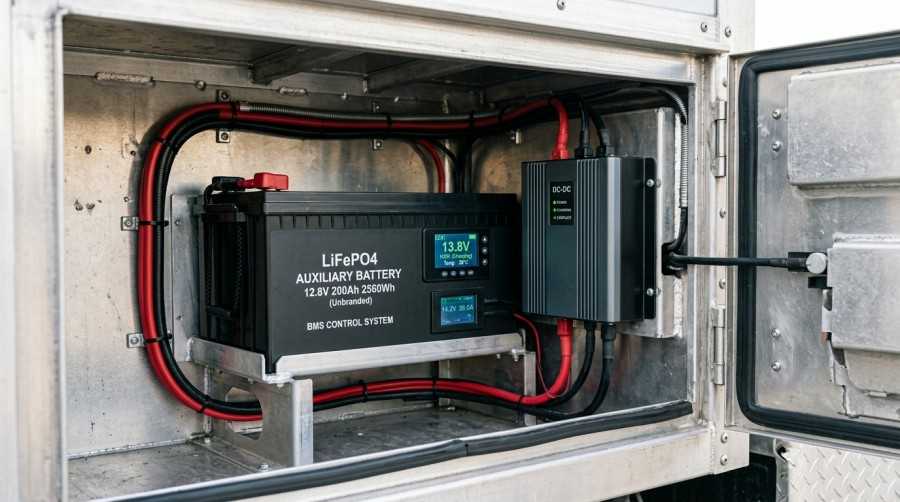
Lithium batteries differ from conventional lead-acid batteries in charging voltage, low-temperature charging limits, overcurrent protection, and disconnect logic. If the alternator directly charges an auxiliary lithium battery without an appropriate DC-DC charging controller, the charging strategy may not meet the battery’s requirements and may also place an unsuitable continuous load on the vehicle alternator.
How to Estimate the Battery Capacity Needed for Truck Parking Loads
Auxiliary battery capacity should not be estimated only by asking how many hours the equipment will operate. Actual equipment power, inverter losses, ambient temperature, usable depth of discharge, and available recharging opportunities should also be considered.
The following simplified formulas can be used for an initial estimate:
Estimated Energy Consumption (Wh) = Equipment Power (W) × Operating Time (h)
Auxiliary Battery Nominal Energy (Wh) = Battery Voltage (V) × Capacity (Ah)
For example, a 60W onboard refrigerator operating for 10 hours would theoretically consume 600Wh. However, compressors normally cycle on and off, and actual energy consumption will vary with ambient temperature, insulation, door-opening frequency, and temperature settings.
If lighting, a router, and a small fan are also used, their energy consumption should be added to the total, with additional allowance for inverter conversion and system losses.
| Equipment Category | Typical Power Behavior | Factors Affecting Energy Consumption | Recommended Measurement |
| Onboard refrigerator | Depends on compressor duty cycle | Ambient temperature, insulation, door-opening frequency, temperature setting | Measure a full day using a DC current meter or battery monitor |
| LED lighting | Generally relatively stable | Number of lights, dimming level, operating time | Record nightly operating time |
| Communication and tracking equipment | Usually low power but operates for extended periods | Signal strength, transmission frequency, standby strategy | Check rated power and measure actual current |
| Inverter | Depends on AC loads | Standby consumption, conversion efficiency, peak loads | Do not rely only on the inverter’s rated output power |
| Parking air conditioner or fan | Highly variable load | Ambient temperature, set temperature, operating mode | Estimate based on hot-weather operating conditions |
These figures are intended for planning purposes. Real-time power consumption can vary between devices.
Before finalizing the system design, consider performing a complete parking-cycle test on the actual truck while recording battery voltage, state of charge, temperature, and load changes.
Daily Truck Battery Maintenance Guide
Truck battery maintenance is not about frequently removing the battery. The goal is to identify undercharging, corrosion, loose mounting, and abnormal power consumption before they cause a breakdown.
For fleet operations, consider maintaining a battery record for each truck that includes installation date, model number, test results, charging voltage, fault codes, and replacement history.
Regularly Inspect the Battery Case and Mounting
Check the enclosure for swelling, deformation, cracks, or signs of electrolyte leakage. Confirm that hold-down brackets, trays, and straps remain secure.
For conventional serviceable lead-acid batteries, electrolyte levels should be checked according to the manufacturer’s instructions. Sealed batteries should not be opened or refilled by the user.
Keep Terminals Clean and Properly Tightened
Terminal corrosion increases contact resistance and can cause voltage drop during starting as well as localized heating.
Before cleaning, switch off vehicle power and follow the disconnection and reconnection sequence specified in the vehicle service manual. After reconnecting, confirm that the terminal clamps are secure and protective covers are correctly positioned.
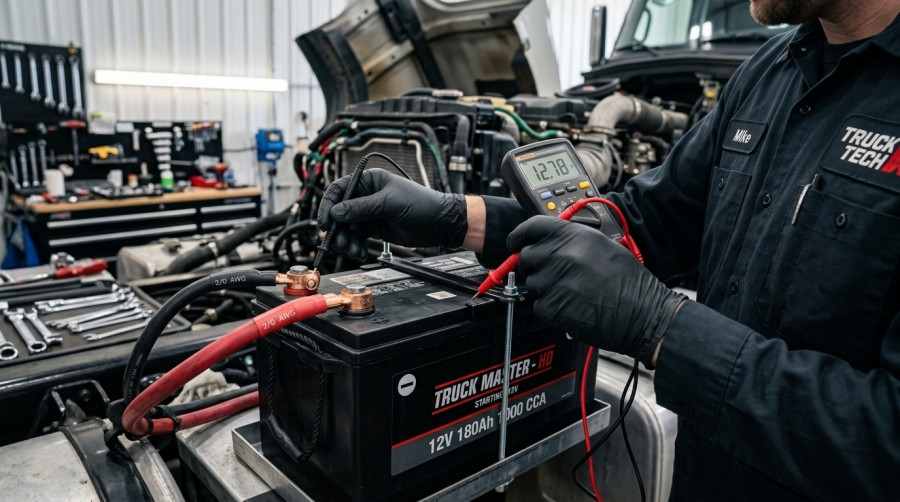
Monitor the Alternator and Charging Voltage
Repeated battery discharge does not necessarily mean the battery itself is defective.
A slipping alternator belt, faulty voltage regulator, poor grounding, excessive wiring voltage drop, or parasitic loads from aftermarket equipment can prevent the battery from reaching a full state of charge.
Charging-voltage requirements vary by vehicle and battery technology, so measurements should be compared with the specifications provided by the vehicle and battery manufacturers.
Avoid Leaving the Vehicle at a Low State of Charge for Long Periods
When a truck remains parked for an extended period, anti-theft systems, tracking terminals, refrigerators, or aftermarket equipment may continue consuming power.
For long-term storage, use an appropriate maintenance charger according to the equipment instructions, or have a qualified technician check the vehicle’s parasitic current draw.
For lead-acid batteries, prolonged operation at a low state of charge can reduce subsequent charge recovery.
Increase Inspection Frequency During Hot and Cold Seasons
High temperatures can accelerate internal chemical reactions and increase the risk of water loss in applicable lead-acid batteries. Low temperatures can reduce usable capacity and increase starting difficulty.
Performing a load test, terminal inspection, and charging-system check before seasonal temperature changes can help identify deteriorating batteries before they cause starting problems.
Common Truck Battery Problems and Troubleshooting Directions
| Symptom | Possible Causes | What to Check |
| Slow cranking or weak starter motor | Low battery charge, increased internal resistance, poor terminal contact | Check open-circuit voltage, voltage under load, terminals, and ground cables |
| Difficult starting even after repeated jump-starts | Charging-system fault, parasitic drain, starter-system problem | Check charging voltage, parasitic current, and starter condition |
| Swollen battery case | Overcharging, overheating, internal failure, or battery ageing | Stop using the battery and have it inspected professionally |
| Repeated terminal corrosion | Venting, connection, charging condition, or environmental factors | Clean terminals and inspect mounting and charging system |
| Significant battery drain after one night of parking | Excessive auxiliary loads, starting battery supporting parking loads, parasitic drain | Measure parked current draw and consider a separate auxiliary power system |
| One battery in a 24V system behaves abnormally | Uneven battery ageing, poor connection, or individual battery failure | Test both batteries for voltage, internal resistance, and charging condition |
| Warning remains after installing a new battery | Vehicle monitoring system not matched or reset, charging-system fault, or wiring issue | Follow vehicle-specific diagnostic and battery-registration procedures |
Truck Battery Selection FAQ
Is a Higher-Capacity Battery Always Better for a Truck?
Not necessarily. Higher capacity may also mean greater size, weight, charging time, and installation requirements.
For starting batteries, CCA, physical dimensions, terminal position, and compatibility with the original charging system are equally important. For auxiliary batteries, capacity should be calculated according to equipment loads and available charging conditions.
Can You Replace a Truck Battery With a Regular Car Battery?
It depends on voltage, CCA, dimensions, mounting method, and vehicle requirements.
Large diesel trucks and 24V systems often have specific starting-output and mechanical requirements that a standard passenger-car battery may not meet. Always verify the original vehicle specifications before replacement.
Can You Replace Only One 12V Battery in a 24V Truck?
If two 12V batteries operate in series, replacing only one creates differences in capacity, internal resistance, and charge acceptance between the new and old batteries.
Whether the remaining battery can continue to be used should be evaluated by a qualified technician. In many maintenance situations, replacing paired batteries with units of the same specification and similar condition is preferred.
Which Is More Important, CCA or Ah?
It depends on the application. Engine starting places greater emphasis on CCA, while parking loads, deep-cycle applications, and auxiliary power systems require more attention to Ah, usable Wh, cycle capability, and charging strategy.
If a truck needs both starting power and extended auxiliary power, the two requirements are often better addressed separately.
My Truck Battery Keeps Going Flat. Should I Replace It Immediately?
First check the battery’s open-circuit voltage and load performance, alternator charging voltage, terminals and ground connections, and parasitic current draw while the truck is parked.
If the underlying problem is excessive parasitic drain, insufficient charging, or a starter-system fault, replacing the battery alone may not solve the problem.
Can a Lithium Battery Be Connected Directly in Parallel With a Lead-Acid Starting Battery?
Direct parallel connection is not recommended without evaluating charging profiles, BMS protection, wiring, fuses, isolation strategy, and possible failure modes.
Lithium auxiliary systems typically require a compatible DC-DC charger or isolation solution. The specific system architecture should be designed by qualified personnel according to the vehicle and battery specifications.
How Should Used Truck Batteries Be Disposed Of?
Used lead-acid and lithium batteries should not be placed in regular household waste. They should be taken to a battery retailer, compliant recycling service, or locally approved recycling facility.
During temporary storage, terminals should be insulated, batteries should be protected against tipping, and they should not be stored loosely with metal objects.
Conclusion: Choose a Truck Battery Based on Real-World Vehicle Operating Conditions
Truck battery selection should start with the vehicle’s actual operating conditions. Engine starting requires reliable high-current output, parking equipment requires a predictable energy reserve, and complex electrical modifications require a complete charging, protection, and wiring strategy.
Confirming the vehicle’s original voltage, CCA, battery dimensions, terminal layout, and auxiliary loads—and then considering seasonal temperatures, road conditions, and operating schedules—can help ensure that the battery system is better matched to the truck’s actual requirements.
HiMASSi is one of the brands of Shenzhen Himax Electronics Co., Ltd. serving the Australian market, with a focus on battery and power requirements for trucks, commercial vehicles, and other demanding applications.
HiMASSi provides technical consultation and product support for starting batteries, auxiliary power systems, lithium battery packs, chargers, accessories, and customized power systems. Specific product specifications, installation methods, compatibility, and operating conditions should be determined based on vehicle documentation, product datasheets, prototype validation, and technical specifications agreed upon by both parties.