
Commercial Disclosure: The HiMASSi® Editorial Team combines local Australian market insight with the battery engineering and manufacturing expertise of Shenzhen Himax Electronics Co., Ltd. to provide practical, technically informed content for businesses, OEMs, system integrators, and industry professionals. As Himax Electronics’ official flagship brand in Australia, HiMASSi® focuses on LiFePO4 batteries, custom battery solutions, BMS technology, charging systems, battery selection, and application-specific power solutions. Our content covers technical guidance, industrial and commercial applications, product updates, and HiMASSi® news. All content reflects HiMASSi®’s official editorial perspective and is intended to help Australian customers evaluate battery solutions based on their application requirements, operating conditions, system compatibility, and project needs.
Key Takeaways
- Forklift battery replacement costs include more than the battery purchase price. Transport, removal and installation, charger compatibility, downtime, maintenance, and old-battery recycling or disposal may also need to be considered.
- Before comparing quotes, use the same vehicle compatibility requirements, operating needs, quote scope, and evaluation period. Voltage and capacity alone are not enough to determine value.
- Lead-acid and lithium batteries have different cost structures. The right comparison should consider the number of shifts, charging opportunities, maintenance requirements, and the forklift’s remaining service life.
- Downtime costs should be calculated based on the actual operating time affected. The entire battery charging period should not automatically be treated as lost productivity.
- Operating records, capacity testing, and detailed quotations can help determine whether it makes more sense to continue repairing the existing battery, replace it with the same battery type, or convert from lead-acid to lithium.
Introduction
Reduced forklift runtime, more frequent charging, or repeated low-battery warnings during lifting often lead warehouse managers to consider battery replacement. However, there is no single answer to the question, “How much does it cost to replace a forklift battery?” without considering the forklift model and operating conditions.
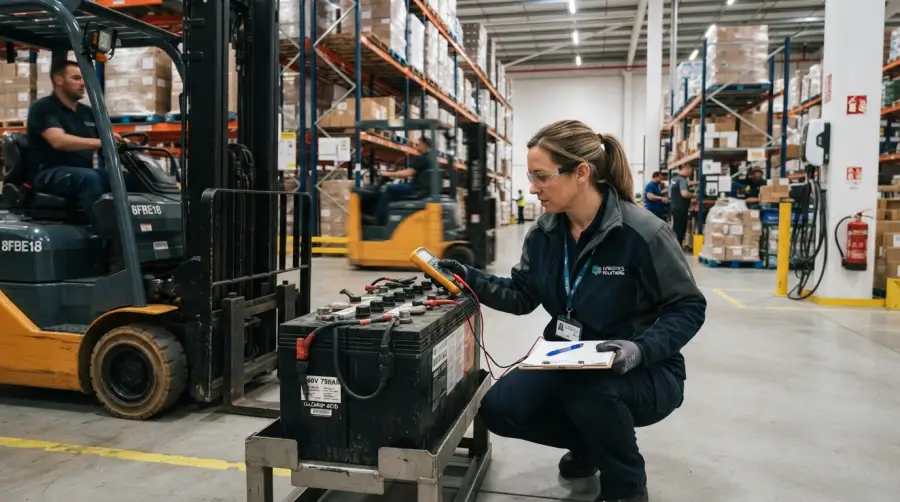
From a battery manufacturing perspective, a replacement battery system needs to meet energy storage, power output, mechanical installation, vehicle control, and charging-management requirements. The purchase price is only one part of the equation. What matters more to the operating budget is: how much will this battery system cost over the planned service period, and how much productive work can it support?
What Costs Are Included in Forklift Battery Replacement?
It can be useful to divide the budget into upfront costs, ongoing operating expenses, and end-of-life costs.
| Cost Item | Main Components | Commonly Overlooked Costs |
| Battery purchase | Cells, enclosure, interconnections, management system, and optional features | Whether heating, communication interfaces, or custom dimensions cost extra |
| Transport and delivery | Packaging, freight, insurance, unloading, and on-site handling | Remote-area delivery and material-handling equipment |
| Removal and installation | Removing the old battery, securing and connecting the new battery, and commissioning | Connector replacement, cable modifications, and mounting brackets |
| Vehicle compatibility | Counterweight, communication, instrument display, and control-interlock verification | Compatibility validation after lead-acid-to-lithium conversion |
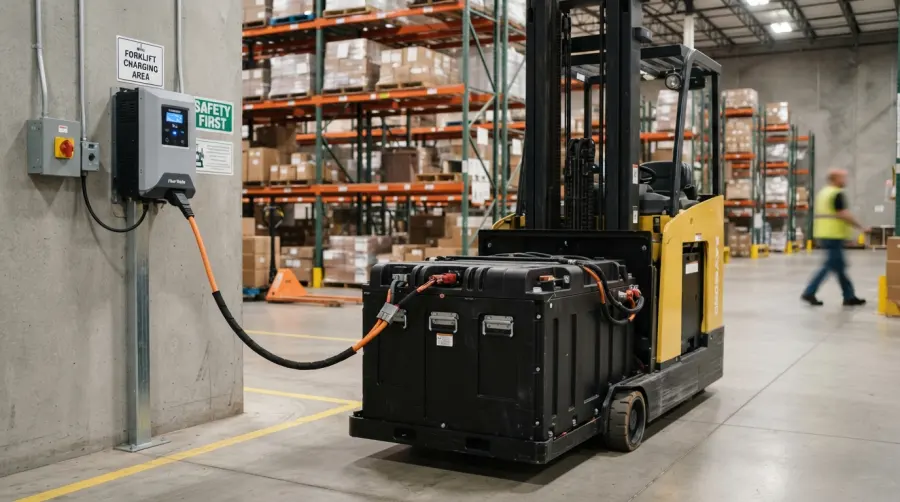
| Charging system | Charger purchase, parameter configuration, and electrical infrastructure changes | Circuit capacity, outlets, and charging-area modifications |
| Downtime and replacement equipment | Installation downtime, waiting for parts, backup forklifts, or rental equipment | Temporary scheduling, overtime, and delayed operations |
| Routine operation | Charging electricity, inspections, maintenance, and related labour | Standby consumption, auxiliary heating, and charging losses |
| Repairs and after-sales support | Diagnostics, replacement parts, on-site service, and transport | Whether the warranty includes labour and return freight |
| Recycling and disposal | Old-battery inspection, recycling transport, and disposal | Whether residual value has already been deducted from the purchase quote |
Not every project will incur every cost listed above. For example, a like-for-like battery replacement may allow the existing charger to remain in service, while changing to a different battery chemistry may require a new charging configuration.
The budget should therefore reflect the actual project rather than simply adding every possible cost category.
Why Do Forklift Battery Purchase Prices Vary?
The Same Voltage and Capacity Do Not Mean the Same Operating Capability
Battery capacity is commonly expressed in Ah. For an initial comparison of stored energy, you can use:
Nominal Energy (kWh) ≈ Nominal Voltage (V) × Rated Capacity (Ah) ÷ 1,000
However, nominal energy does not directly indicate how much energy will actually be available during a shift. Discharge rate, operating temperature, permitted usable energy range, and protection settings can all affect real-world output.
For lead-acid batteries, the discharge-hour rate associated with the rated capacity should also be checked. Capacity figures obtained under different test conditions should not be compared directly.
When requesting a quote, provide not only voltage and capacity but also continuous operating current, starting or lifting peak current, and actual daily operating hours.
Battery Pack Design and Manufacturing Configurations Differ
From a manufacturing perspective, cell consistency, interconnection design, enclosure strength, insulation, temperature monitoring, and end-of-line testing all affect cost.
Lithium battery systems may also include a battery management system (BMS), contactors, fuses, pre-charge circuits, and communication interfaces. Cold-storage, humid, or dusty environments may require additional thermal-management or protection features.
These features should correspond to the actual operating environment. Simply adding more features does not necessarily improve operating results, while omitting necessary features may lead to compatibility problems and downtime.
Quotations May Include Different Services
Some quotations cover only the battery, while others include the charger, installation and commissioning, freight, or on-site support.
When comparing forklift battery prices, confirm exactly what is included in each quotation.
For Australian procurement projects, comparisons should also use consistent conditions for AUD pricing, GST inclusion, and delivery location. Prices quoted under different commercial terms should not be compared directly.
Why Can’t the Cost of Converting a Forklift From Lead-Acid to Lithium Be Calculated From the Battery Price Difference Alone?
A lead-acid-to-lithium forklift conversion requires evaluation of the entire power system rather than simply removing the old battery and installing a new one.
Mechanical Installation and Counterweight
Battery-compartment dimensions, mounting methods, cable routing, and permitted battery weight all need to be checked.
On some forklifts, the battery contributes to the vehicle’s counterweight. Replacing it with a significantly lighter battery may therefore require an appropriate counterweight solution.
Charger and Control System
An existing lead-acid charger should not automatically be used with a lithium battery simply because the nominal voltages are similar.
Charging voltage, current, charging profile, communication protocols, and protection interlocks should all be verified for compatibility.
Battery-level displays, low-SOC power limiting, and fault-warning logic should also be checked. Otherwise, the battery may be electrically capable of powering the forklift while the vehicle cannot correctly interpret its status.
Operating and Shift Schedules
If the new battery strategy relies on opportunity charging during breaks, confirm that suitable charging locations are available and that operators can connect the chargers according to the planned schedule.
A battery supporting opportunity charging does not necessarily mean that the warehouse has enough practical charging opportunities.
For this reason, a lead-acid-to-lithium conversion budget should also consider commissioning, staff training, and operational workflow changes.
How Should Forklift Battery Downtime Costs Be Calculated?
Downtime costs are easy to overlook, but they can also be overestimated. The key is to distinguish between time when the forklift is not operating and time when production is actually affected.
For example, if a forklift is charged overnight during non-operating hours, the entire charging period should not automatically be counted as daytime productivity loss. Similarly, if an available backup forklift can take over during battery replacement, the same period should not be calculated as a complete shutdown of the operation.
One approach is:
Downtime-Related Cost = Additional Replacement Equipment Cost + Additional Labour or Overtime Cost + Operational Losses Not Covered by Replacement Measures
If the business already has reliable data for downtime cost per hour, another method is:
Downtime Loss = Actual Affected Hours × Loss per Hour
Avoid double counting when using either method.
For example, if a rental forklift has already maintained normal operations, the same hours should not also be calculated as complete production losses.
Consider recording the following information:
- How much scheduled operating time will battery replacement consume?
- Will waiting for parts or technicians create additional downtime?
- Can the backup forklift perform the same load-handling and lifting tasks?
- Will temporary scheduling changes create rental, overtime, or transport expenses?
How Should Maintenance and Charging Electricity Costs Be Compared?
Lead-Acid Battery Maintenance: Distinguish Between Different Technologies
Flooded lead-acid traction batteries commonly require electrolyte-level inspections, watering as specified, terminal cleaning, and appropriate charging management.
However, maintenance requirements differ between lead-acid battery technologies, so a single fixed maintenance schedule should not automatically be applied to every product.
Annual maintenance costs can be calculated as:
Annual Maintenance Cost = Annual Number of Maintenance Events × Labour Hours per Service × Labour Rate + Consumables + External Service Costs
If maintenance interrupts operations, the associated downtime can be recorded separately, while avoiding duplication with labour costs.
Lithium Battery Maintenance: No Watering Does Not Mean No Inspection
Lithium batteries generally do not require watering, but connectors, cables, mounting hardware, and enclosures still need to be inspected according to the product requirements.
Fault records, abnormal temperatures, and cell consistency may also need to be monitored.
When comparing forklift battery maintenance costs, use a clearly defined list of maintenance tasks rather than automatically assigning zero maintenance cost to a particular battery chemistry.
Charging Electricity Costs: Use Grid-Side Measurements Where Possible
A practical calculation is:
Annual Charging Electricity Cost = Annual Grid-Side Charging Energy Consumption × Applicable Electricity Rate
Using grid-side energy records from the charging circuit or charging equipment allows charging losses to be included in the measurement.
If auxiliary heating or ventilation equipment is also used, include it according to the actual electrical system boundary.
If battery-output energy is used instead, charger and battery charge/discharge losses need to be considered. If grid-side measurements are already being used, these losses should not be added again.
Forklift Battery Total Cost of Ownership Example
Total cost of ownership, or TCO, compares purchase and operating expenses over the same evaluation period.
Total Cost Over the Evaluation Period = Initial Investment + Electricity Costs + Maintenance and Repair Costs + Downtime and Replacement Equipment Costs + Additional Investment During the Period + End-of-Life Disposal Costs − Residual Value
The following example compares two hypothetical solutions over three years, assuming both meet the same operating requirements. The figures are for calculation purposes only, are in Australian dollars, and do not represent market prices, HiMASSi® quotations, or the typical cost of any particular battery technology.
| Cost Item | Option A | Option B |
| Battery purchase | 10,000 | 15,000 |
| Charging equipment, compatibility modifications, and installation | 1,500 | 3,000 |
| Three-year charging electricity cost | 6,000 | 5,100 |
| Three-year maintenance and repair cost | 3,600 | 1,800 |
| Three-year downtime and replacement equipment cost | 3,000 | 1,500 |
| End-of-life disposal cost less residual value | −800 | −500 |
| Three-year total cost | 23,300 | 25,900 |
In this example, Option B has lower operating costs, but those savings do not offset its higher initial investment over the three-year evaluation period.
This demonstrates why lower maintenance requirements alone do not necessarily mean lower total cost, just as a lower purchase price does not automatically make one option more economical.
The number of shifts, labour costs, downtime impact, and evaluation period can all change the result.
For longer evaluation periods, the analysis should also include any additional battery replacements, charger upgrades, and the time value of money. Residual value should be estimated according to the actual expected condition at the end of the period.
Neither option should be assumed to operate through the entire evaluation period without repairs or degradation.
How Can You Reduce Unnecessary Costs Before Replacing a Forklift Battery?
Diagnose the Problem Before Replacing the Entire Battery Pack
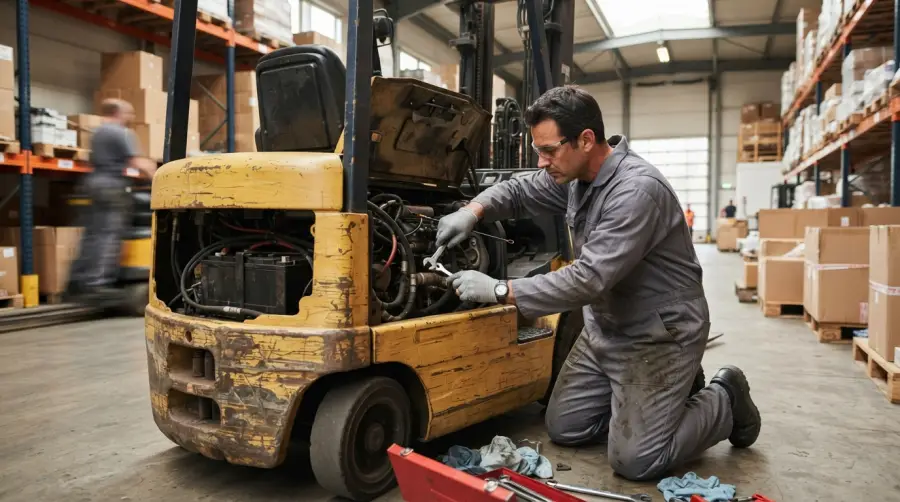
Reduced runtime is not always caused entirely by battery capacity degradation. Charger faults, increased connection resistance, temperature changes, or higher operating loads can also contribute.
Consider checking capacity, loaded voltage, cell-to-cell differences, connection condition, and charging records.
If partial repair is being considered, evaluate the consistency between new and existing cells, reliability after repair, and any impact on warranty coverage.
Match the Solution to the Forklift’s Remaining Service Life
If the forklift is scheduled for retirement within a relatively short period, battery investment should be evaluated against the vehicle’s remaining service life.
Whether the battery can later be transferred to another forklift depends on dimensional, electrical, and communication compatibility and should not be assumed.
Review Warranty Terms in Detail
In addition to warranty duration, check capacity-retention requirements, operating-hour or energy-throughput limits, environmental conditions, maintenance obligations, and whether labour, freight, and temporary replacement equipment are covered.
Cycle-life figures should also be interpreted according to test temperature, depth of discharge, and end-of-life criteria. A stated number of cycles should not be directly converted into a fixed number of years in service.
Forklift Battery Replacement Cost FAQ
How Much Does It Cost to Replace a Forklift Battery, and Why Does the Supplier Need the Forklift Model?
The forklift model determines the voltage platform, battery-compartment dimensions, permitted weight range, electrical interfaces, and operating power requirements.
Without this information, a quotation may omit necessary items such as counterweights, connectors, or charging equipment.
If a Lithium Battery Costs More Upfront, Does That Mean It Isn’t Cost-Effective?
Not necessarily.
Multi-shift operations, high maintenance labour costs, or applications where battery changes significantly affect operations may have very different cost structures.
Compare total costs under the same operating workload and evaluation period rather than relying only on the initial battery price.
If a Failure Occurs During the Warranty Period, Does That Mean There Will Be No Additional Costs?
Not necessarily.
Check whether the warranty covers on-site labour, transport, removal and installation, and temporary replacement equipment. Even if the repair itself is covered under warranty, operational costs may still arise while waiting for service.
Can the Value of an Old Forklift Battery Be Deducted From the Cost of a New Battery?
It depends on the battery type, condition, recycling channel, and commercial terms.
Obtain a clear recycling or buy-back quotation and confirm transport and processing costs. If the residual value of the old battery has already been deducted from the new-battery quotation, do not deduct it again in the cost analysis.
Does a Shorter Charging Time Mean an Equal Reduction in Downtime?
Not necessarily.
A financial benefit is created only when charging occupies required operating time and shortening the charging period actually increases productive availability.
Break schedules, the number of available chargers, and the site’s electrical capacity should also be considered.
What Information Is Needed to Obtain a Complete Forklift Battery Quote?
Provide the forklift model, existing battery nameplate information, installation dimensions, weight requirements, charger information, number of daily shifts, operating environment, and recent runtime and fault records.
Also ask the supplier to clearly specify the scope of freight, installation, commissioning, and after-sales support in the quotation.
HiMASSi Forklift Batteries
HiMASSi is an official flagship brand developed by Shenzhen Himax Electronics Co., Ltd. for the Australian market. For forklift battery replacement projects, HiMASSi recommends evaluating vehicle compatibility, actual energy consumption, charging conditions, and maintenance requirements together so that purchasing decisions are based on clear technical specifications and transparent cost components.
If you are planning a forklift battery replacement, you can provide HiMASSi with information about the forklift and its existing battery to discuss product selection and quotation scope. Final configuration, performance, and service details should be based on the applicable product technical documentation and the solution agreed by both parties.