
Commercial Disclosure: The HiMASSi® Editorial Team combines local Australian market insight with the battery engineering and manufacturing expertise of Shenzhen Himax Electronics Co., Ltd. to provide practical, technically informed content for businesses, OEMs, system integrators, and industry professionals. As Himax Electronics’ official flagship brand in Australia, HiMASSi® focuses on LiFePO4 batteries, custom battery solutions, BMS technology, charging systems, battery selection, and application-specific power solutions. Our content covers technical guidance, industrial and commercial applications, product updates, and HiMASSi® news. All content reflects HiMASSi®’s official editorial perspective and is intended to help Australian customers evaluate battery solutions based on their application requirements, operating conditions, system compatibility, and project needs.
Key Takeaways
- When choosing a forklift battery for a freezer warehouse, evaluate low-temperature discharge capability, charging temperature range, actual usable energy, and vehicle compatibility—not just rated capacity.
- A battery that can discharge at low temperatures may not be able to charge safely at the same temperature. Charging decisions should be based on actual cell temperature.
- Forklift runtime in cold storage depends on load weight, lifting frequency, travel routes, time spent inside the freezer, and energy consumed by battery heating. Runtime should therefore be evaluated against actual shift conditions.
- For lithium batteries with integrated heating, verify the heating power source, warm-up time, temperature monitoring, and charging interlock logic.
- Forklifts that frequently move between freezer and warmer areas may be exposed to condensation. Moisture protection for the battery enclosure, connectors, and the vehicle’s electrical system should all be considered when selecting a battery.
Introduction
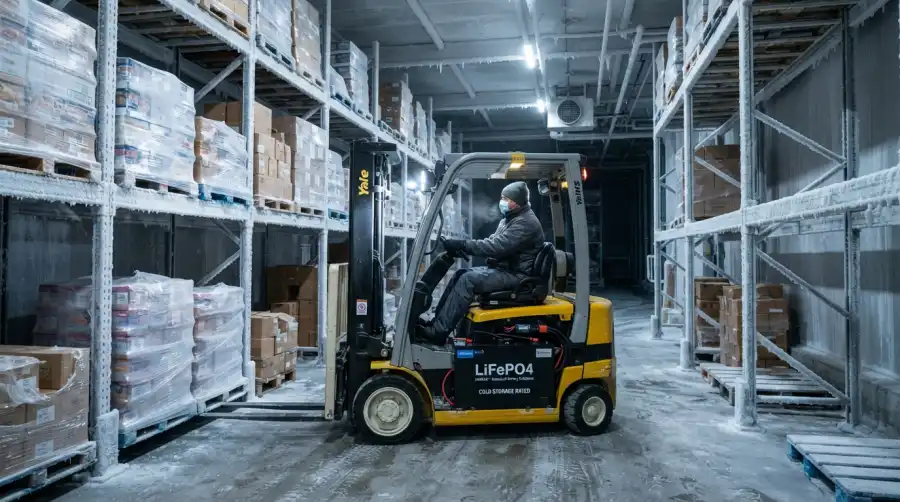
Forklifts operating in freezer warehouses often work under a combination of low temperatures, heavy loads, and continuous-duty conditions. If battery selection is based only on room-temperature specifications, actual operation may result in shorter runtime, greater voltage drop during lifting, and longer charging wait times.
From a battery manufacturing and system-matching perspective, selecting a forklift battery for cold storage should focus on three questions: How much energy can the battery actually deliver at the operating temperature? Can it handle the required operating current? And can it be effectively recharged between shifts?
Why Do Low Temperatures Affect Forklift Battery Performance?
Low temperatures affect ion transport and electrochemical reactions inside a battery, increasing internal resistance and polarization. For forklifts, this can result in reduced usable capacity and more noticeable voltage drop during startup, climbing, or lifting. The degree of performance change varies with battery chemistry, discharge rate, and temperature, so a single capacity-loss percentage should not be applied to every battery.
Reduced Usable Energy Does Not Necessarily Mean the Battery Is Damaged
Some capacity loss caused by low temperatures may be recovered after the battery returns to an appropriate operating temperature. However, charging outside specified conditions, excessive discharge, or other abnormal operating conditions may cause lasting performance degradation.
For this reason, determining whether a cold-storage forklift battery has aged requires testing under specified temperature, charging, and discharging conditions. A single measurement of runtime during one freezer-warehouse shift is not enough to determine battery health.
Ambient Freezer Temperature Is Not the Same as Cell Temperature
A forklift that enters a freezer for a short period may have a very different internal battery temperature from one that has been parked in the freezer overnight.
Similarly, when a battery is moved into a warmer area, its enclosure may warm up before the cells inside reach the same temperature. Battery selection and charging control should account for this thermal lag.
How Do You Choose a Forklift Battery for Cold Storage? Start With Real Operating Conditions
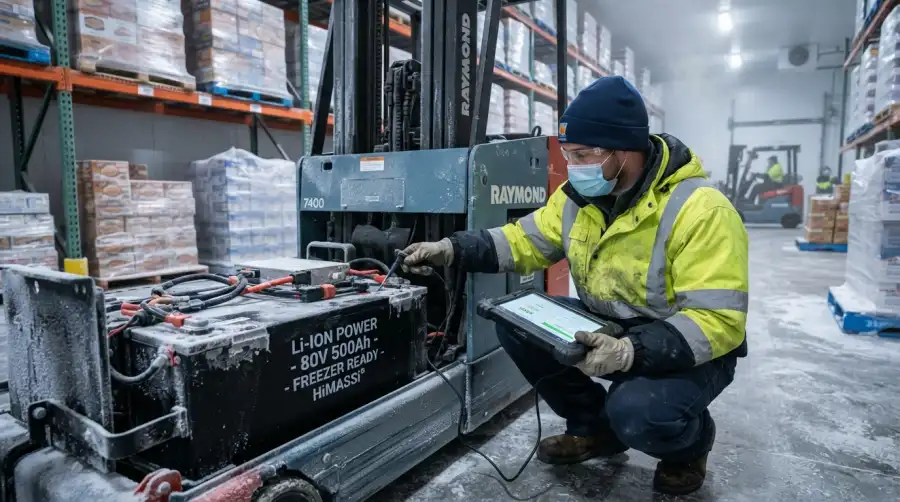
Before requesting a quote from a battery supplier, it is helpful to prepare the following information. The more complete the operating data, the easier it is to determine the appropriate capacity, heating configuration, and charging equipment.
| Selection Factor | Information to Provide | Impact on Battery Selection |
| Temperature conditions | Freezer temperature range, charging-area temperature, and parking location | Determines charging/discharging limits and heating requirements |
| Freezer operating pattern | Continuous time inside the freezer, frequency of entry and exit, and parking duration | Affects cell temperature and condensation risk |
| Vehicle specifications | Forklift model, rated voltage, battery compartment dimensions, and allowable battery weight | Determines electrical and mechanical compatibility |
| Load profile | Load weight, lifting height, and grade requirements | Affects continuous and peak current requirements |
| Shift schedule | Shift duration, number of shifts per day, and break intervals | Determines battery capacity and recharging strategy |
| Energy-use records | Energy consumed per shift, remaining state of charge, and alarm records | Provides a basis for runtime estimation |
| Charging conditions | Available power supply, charger model, and available charging windows | Determines whether sufficient energy can be replenished in time |
For example, two forklifts operating at −20°C may require different battery configurations if one frequently returns to a room-temperature loading dock while the other remains inside the freezer for extended periods.
When purchasing a battery, ask the supplier to specify the low-temperature test conditions, including cell temperature, cold-soak duration, discharge current, and cutoff voltage. A general statement such as “suitable for low-temperature operation” is not enough to determine whether the battery can support a full shift.
Lead-Acid or LiFePO4 Batteries for Cold-Storage Forklifts?
Both options should be evaluated based on the specific battery and operating schedule. Suitability should not be determined by battery chemistry alone.
| Comparison | Lead-Acid Traction Battery | LiFePO4 Forklift Battery |
| Low-temperature discharge | Capacity reduction and voltage behavior under load should be evaluated | Low-temperature performance also changes; both cell-level and pack-level data should be reviewed |
| Charging management | Uses a compatible charging profile, with temperature compensation and maintenance as required by the product | The battery management system monitors temperature and coordinates with the charger to limit or stop charging |
| Opportunity charging | Suitability depends on battery type and charging strategy | Opportunity charging can be considered but is limited by temperature, allowable charging current, and available charging windows |
| Routine maintenance | Flooded products typically require watering, terminal inspection, and other maintenance | Usually does not require watering, but connectors, enclosures, and operating records should still be inspected |
| Retrofit compatibility | Must meet the forklift’s specified dimensions, weight, and interface requirements | In addition to these requirements, communication, counterweight, and control logic should also be verified |
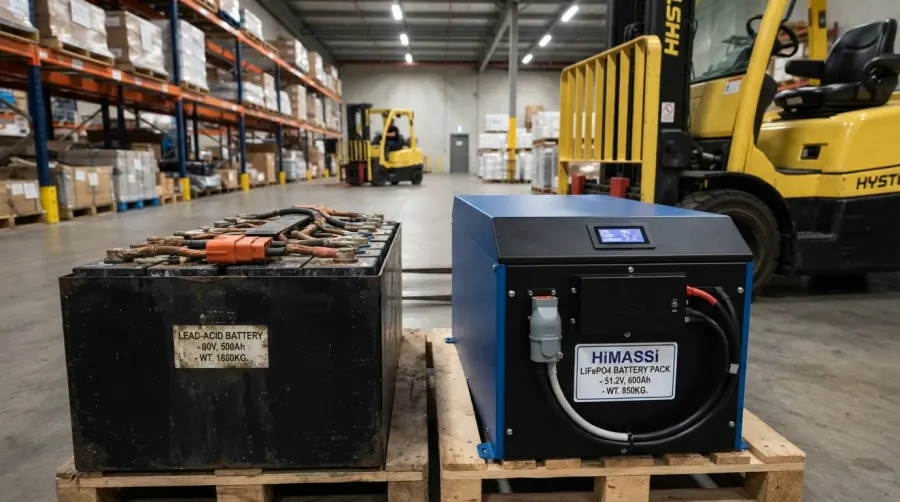
For warehouses with an established lead-acid battery maintenance program and predictable shift schedules, the existing solution can be evaluated using actual operating data. Warehouses requiring frequent recharging or multi-shift operation may also consider lithium battery solutions with appropriate thermal-management systems.
When converting from lead-acid to lithium, the forklift manufacturer or a qualified technical professional should confirm battery weight and counterweight requirements. On some forklifts, the battery contributes to the vehicle’s counterbalance, so replacing it with a significantly lighter battery may affect stability.
How Do You Estimate Cold-Storage Forklift Battery Runtime?
Compare Energy Before Comparing Amp-Hours
Rated capacity is typically expressed in Ah, but comparing Ah alone does not indicate how much energy batteries with different voltages can store. For an initial estimate, use:
Nominal Energy (kWh) ≈ Nominal Voltage (V) × Rated Capacity (Ah) ÷ 1,000
For example, a battery rated at 51.2V and 400Ah has approximately 20.48kWh of nominal energy. This nominal energy does not mean that the entire amount will be available for forklift operation inside a freezer warehouse.
Account for Low Temperature, Planned Usage Range, and Heating Energy
For preliminary battery sizing, the following approach can be used:
Energy Available for Operation ≈ Nominal Energy × Low-Temperature Usable Energy Factor × Planned Usage Ratio − Battery-Side Auxiliary Energy Consumption
The low-temperature usable energy factor should come from testing under conditions representative of the intended application. The planned usage ratio accounts for the energy reserve maintained during operation, while auxiliary consumption includes energy used by battery-powered heating systems and other battery-side loads.
The following example is for calculation purposes only. It does not represent HiMASSi® product specifications or universal performance at any particular temperature.
| Calculation Item | Example Assumption | LiFePO4 Forklift Battery |
| Nominal energy | 20.48kWh | Low-temperature performance also changes; both cell-level and pack-level data should be reviewed |
| Low-temperature usable energy factor | 0.8 | The battery management system monitors temperature and coordinates with the charger to limit or stop charging |
| Planned usage ratio | 0.9 | Opportunity charging can be considered but is limited by temperature, allowable charging current, and available charging windows |
| Battery-side auxiliary energy consumption during one operating cycle | 1.00kWh | Usually does not require watering, but connectors, enclosures, and operating records should still be inspected |
| Energy available for operation | Approx. 13.75kWh | In addition to these requirements, communication, counterweight, and control logic should also be verified |
| Average battery-side power during the same operating cycle, excluding the auxiliary consumption above | 2.50kW | |
| Estimated operating time | Approx. 5.5 hours |
In actual applications, heating energy consumption may vary with operating time and temperature and should therefore be measured or iteratively estimated for the target shift. If measured usable energy already accounts for the reserved energy range or heating consumption, those factors should not be deducted again.
Before purchasing, consider running a representative shift test and recording energy consumption per shift, number of lifting cycles, time spent inside the freezer, and remaining state of charge at the end of the shift. Battery capacity should also allow for future performance degradation and changes in operational demand.
What Should You Know About Charging Lithium Forklift Batteries in Cold Storage?
Understand the Difference Between Charging and Discharging Temperature Ranges
The allowable charging temperature range of a lithium battery is often more restricted than its discharge temperature range. For common lithium-ion batteries with graphite anodes, charging at low temperatures may increase the risk of lithium plating. Always follow the temperature and current limits specified for the particular product.
For example, some Trojan lithium battery products prohibit charging when the internal battery temperature is below 0°C and limit charging current within other lower-temperature ranges. This illustrates how charging management may use different control stages rather than simply allowing full-power charging whenever the temperature is above 0°C. These specifications apply to the corresponding Trojan products and should not be applied directly to other forklift batteries.
For Heated Batteries, Check the Control Logic
When evaluating a heated forklift battery, confirm:
- Whether the heating system is powered by the charger or uses energy from the battery itself.
- How long it takes to raise the battery from the target freezer temperature to the allowable charging temperature.
- Whether temperature sensors monitor representative cell locations.
- How the system responds to a heater or temperature-sensor fault.
- Whether the battery management system can prevent charging when the cell temperature is too low.
A “heated battery” does not necessarily mean charging can begin immediately. Warm-up time must be included in the available charging window between shifts.
Plan for the Complete Recharging Process
The total charging window should account for preheating, actual charging, and any applicable end-of-charge current reduction or balancing process. It should not be estimated simply by dividing battery capacity by the charger’s rated current.
A recommended process is:
- Park the forklift in the designated charging area and follow the required vehicle shutdown procedures.
- Inspect the battery, plugs, and cables for damage, ice, or visible moisture.
- Check cell temperature, remaining state of charge, and fault status.
- Preheat the battery as required and begin charging only after the system permits it.
- Use a compatible charger and record any abnormal current limiting, charging interruptions, or alarms.
Do not bypass low-temperature protection or manually change charging parameters simply to reduce waiting time.
Why Does Condensation Matter When Forklifts Frequently Move In and Out of Freezers?
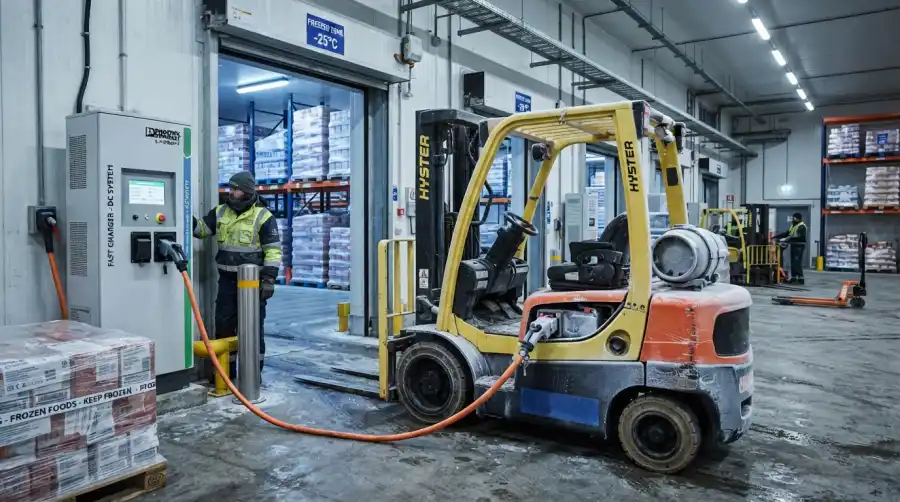
When a cold forklift enters a warmer, more humid area, condensation may form on its surfaces. If the forklift then returns to the freezer, that moisture may freeze. This can increase operating risks for connectors, wiring harnesses, and other electrical components.
For this reason, environmental protection for a freezer-warehouse forklift battery should not be evaluated based on a single IP rating alone. Connector protection, enclosure sealing, resistance to temperature cycling, and inspection and drying requirements for charging interfaces should also be considered.
Warehouses can reduce unnecessary transitions between cold and warm areas through route planning and manage buffer zones and parking times according to the requirements of the forklift and battery suppliers. Even if the battery itself is suitable for freezer operation, the vehicle controller, wiring harnesses, and other components must also be appropriate for the same environment.
Frequently Asked Questions About Cold-Storage Forklift Batteries
If a Freezer Operates at −20°C, Is a Battery Rated to Discharge at −20°C Enough?
Not necessarily. A discharge temperature rating only indicates that the product is permitted to operate under specified conditions. It does not directly indicate usable energy, peak power, or shift runtime. Review test data collected after sufficient cold soaking and confirm that the test load is representative of the actual forklift application.
Does a Larger Battery Capacity Always Mean Better Runtime for a Cold-Storage Forklift?
Increasing battery capacity generally provides more stored energy, but battery compartment dimensions, allowable weight, charging capability, and available charging time also impose limits. If the additional capacity cannot be adequately replenished between shifts, the operational benefit may be less than expected.
Why Does the Forklift Limit
Lifting Even When the Battery Gauge Shows Remaining Charge?
This may be caused by voltage drop under load due to low temperature, low state of charge, or battery aging. Cell voltage imbalance, connection problems, or vehicle control limits may also be involved. Battery management system data and vehicle fault records should be reviewed as part of the diagnosis.
Can the Battery Be Charged Immediately After Moving the Forklift Into a Room-Temperature Area?
Charging should be based on actual cell temperature and the battery manufacturer’s requirements. Warmer ambient air does not mean the cells inside the battery have already reached an allowable charging temperature. The charging interface should also be checked for condensation.
Does a Self-Heating Battery Reduce Runtime?
If the heating system draws energy from the battery itself, some of the stored energy that could otherwise be used for forklift operation will be consumed by heating. If an external power source supplies the heat, available power and warm-up time must be considered instead. The actual impact depends on insulation, temperature difference, heating-control strategy, and operating schedule.
What Technical Information Should You Request When Purchasing a Cold-Storage Forklift Battery?
Request the applicable product datasheet, low-temperature charging and discharging test conditions and results, heating strategy, charger compatibility requirements, vehicle installation requirements, and warranty terms. Where testing or certification is involved, verify the specific models and scope covered by the relevant reports.
About HiMASSi
HiMASSi is the official flagship brand of Shenzhen Himax Electronics Co., Ltd. for the Australian market. When selecting batteries for freezer-warehouse forklifts, HiMASSi emphasizes evaluating low-temperature performance, shift energy consumption, charging conditions, and vehicle compatibility under the same real-world operating conditions. If you are planning to purchase or replace cold-storage forklift batteries, you can provide HiMASSi with your forklift model, freezer temperature, daily shift schedule, and existing battery specifications to discuss suitable products and configurations. Specific performance, features, and service scope are subject to the technical documentation for the applicable model and the solution agreed upon by both parties.