
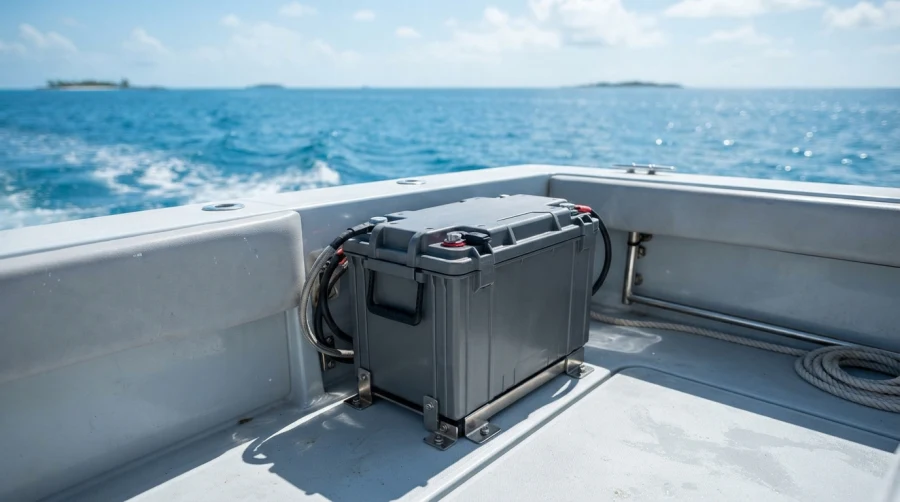
Commercial Disclosure: The HiMASSi® Editorial Team combines local Australian market insight with the battery engineering and manufacturing expertise of Shenzhen Himax Electronics Co., Ltd. to provide practical, technically informed content for businesses, OEMs, system integrators, and industry professionals. As Himax Electronics’ official flagship brand in Australia, HiMASSi® focuses on LiFePO4 batteries, custom battery solutions, BMS technology, charging systems, battery selection, and application-specific power solutions. Our content covers technical guidance, industrial and commercial applications, product updates, and HiMASSi® news. All content reflects HiMASSi®’s official editorial perspective and is intended to help Australian customers evaluate battery solutions based on their application requirements, operating conditions, system compatibility, and project needs.
Key Takeaways
- A car starting battery may be able to start a marine engine under certain conditions, but being able to start the engine does not mean it is suitable for long-term marine use.
- Marine batteries include starting, deep-cycle, and dual-purpose types and should be selected according to different tasks such as engine starting and powering onboard equipment.
- The differences between car and marine batteries go beyond capacity. Discharge characteristics, cycling capability, vibration resistance, installation environment, and charging compatibility also matter.
- Two batteries labeled “12V” or “100Ah” may be designed for very different applications, so voltage or capacity alone should not determine whether they are interchangeable.
- Before replacing a lead-acid battery with a LiFePO4 battery, verify the engine manufacturer’s requirements, charging system compatibility, and the battery management system’s current limits.
Can You Use a Car Battery in a Boat?
A car battery may be able to start a marine engine under certain conditions, but it should not be treated as a long-term replacement for a marine battery simply because the voltage matches and the engine starts.
In this article, “car battery” primarily refers to the low-voltage starting battery commonly used in gasoline and diesel vehicles, not the high-voltage traction battery found in electric vehicles.
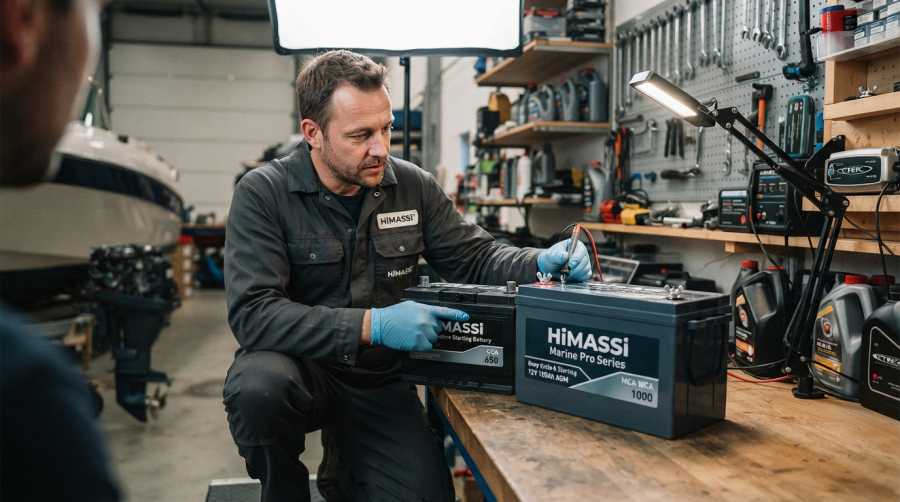
The primary purpose of a car starting battery is to deliver high current for a short period to crank the starter motor. Marine engines have a similar starting requirement, so when voltage, starting capability, terminal connections, and other specifications are compatible, a car battery may be capable of starting certain marine engines.
However, electrical demands on a boat are often more complex. After the engine is switched off, lighting, fish finders, communication equipment, refrigerators, and electric trolling motors may continue drawing power. If a conventional automotive starting battery is used for these loads, repeated deep discharges may accelerate battery degradation and could reduce the reserve available for the next engine start.
From a battery manufacturing and system-selection perspective, determining whether one battery can replace another requires evaluating electrical performance, mechanical suitability, and equipment manufacturer requirements, rather than simply checking whether the battery fits into the existing compartment.
What Types of Marine Batteries Are Available?
“Marine” describes the application environment, but it does not mean that all marine batteries have the same discharge characteristics. Common marine batteries can generally be divided into three categories according to their intended use.
| Type | Primary Purpose | Key Selection Factors | Application Limits |
| Marine starting battery | Delivers high current for a short period to start the engine | Starting current, cold-weather performance, terminal and installation compatibility | Should not automatically be assumed suitable for frequent deep cycling |
| Marine deep-cycle battery | Provides sustained power for trolling motors, lighting, and onboard equipment | Usable capacity, cycle performance, continuous discharge capability | May not meet engine-starting requirements |
| Marine dual-purpose battery | Supports engine starting and a certain amount of sustained power use | Whether both starting and cycling performance meet application requirements | Must be evaluated according to load size and frequency of use |
This application-based distinction can also be found in battery manufacturers’ product information: starting batteries emphasize short-duration power output, deep-cycle batteries emphasize sustained energy delivery, and dual-purpose batteries are designed to support aspects of both applications.
AGM, flooded lead-acid, and LiFePO4, however, describe battery technologies or construction types and are not the same as these application categories.
For example, an AGM battery may be designed either for starting or for deep-cycle applications. The AGM label alone does not mean that the battery is suitable for powering onboard equipment over extended periods.
Key Differences Between Car Batteries and Marine Batteries
Design Priorities: Short-Term Starting Power vs. Sustained Energy Delivery
A typical automotive lead-acid starting battery uses plate structure, active surface area, and other design characteristics to support high-current output for short periods.
Deep-cycle lead-acid batteries place greater emphasis on durability under repeated charge and discharge conditions. Manufacturers may design the plates, active materials, and supporting structures specifically for sustained discharge and cycling applications.
Deep-Cycle Capability: Having Capacity Does Not Mean a Battery Is Designed for Repeated Deep Discharge
Two batteries can have the same Ah rating but very different cycling performance.
Capacity indicates how much charge a battery can deliver under specified test conditions. Cycle performance, however, depends on depth of discharge, temperature, charging method, and the end-of-life criteria used during testing.
When comparing marine deep-cycle batteries, review the test conditions associated with cycle-life figures rather than comparing marketing numbers alone.
Keeping an automotive starting battery at a low state of charge for extended periods or repeatedly subjecting it to deeper discharges is generally unfavorable for service life. If onboard equipment needs power for extended periods, battery selection should prioritize sustained energy requirements.
Construction and Environment: Marine Applications Require Greater Attention to Vibration, Moisture, and Mounting
Vibration, impact, vessel movement, and moisture can place additional demands on the battery enclosure, internal connections, terminals, and mounting system.
Some marine batteries are designed with these conditions in mind, but actual capability should still be verified using the specifications and test information for the specific model.
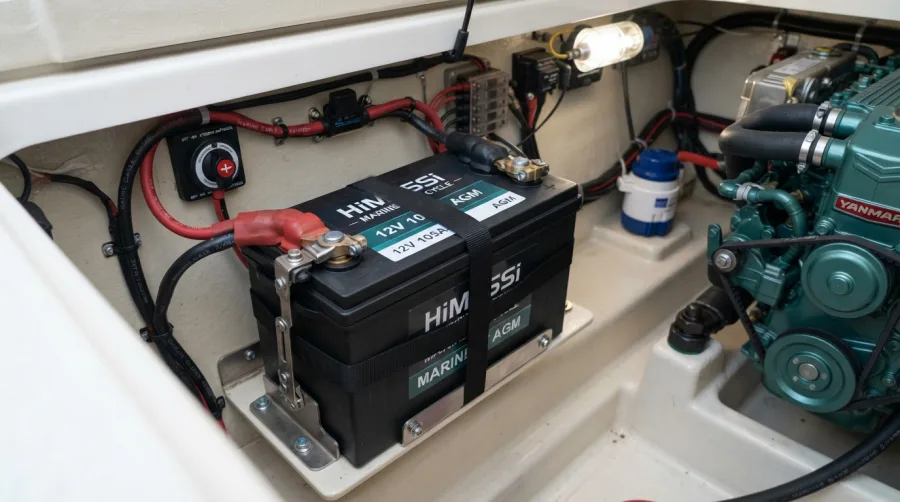
“Marine” does not mean waterproof, and “maintenance-free” does not mean inspection-free.
When selecting a battery, verify permitted mounting orientation, environmental protection requirements, and securing methods. Protect terminals from seawater spray and contact with metal objects. Batteries that require venting should also be installed with appropriate ventilation according to the manufacturer’s instructions.
Charging Compatibility: The Same Nominal Voltage Does Not Guarantee Direct Compatibility
Whether a battery can operate correctly with a boat’s electrical system also depends on the engine alternator, shore-power charger, solar charge controller, and battery isolation equipment.
Different battery types require appropriate charging profiles. Even within the lead-acid family, charging parameters should be configured according to the specific battery model rather than automatically reusing settings from the previous battery.
What Specifications Should You Check When Choosing a Marine Battery?
| Specification or Information | What It Tells You | How to Use It for Battery Selection |
| Nominal voltage | Voltage level of the battery or battery pack | Match it with the engine, loads, and charging system |
| CCA/MCA | Starting-current capability under specified test conditions | Compare with engine requirements and remember that CCA and MCA use different test conditions |
| Capacity (Ah) | Amount of charge available under a specified discharge rate | Review the test rate rather than treating Ah as direct runtime |
| Energy (Wh) | Nominal amount of stored battery energy | Useful for estimating equipment energy consumption and runtime |
| Continuous/peak discharge current | Ability to support sustained and short-duration high-current loads | Compare with load current and allowable peak-current duration |
| Cycle life and test conditions | Cycling performance under specified conditions | Compare depth of discharge, temperature, and capacity-retention criteria |
| Dimensions, terminals, and mounting requirements | Mechanical and electrical installation compatibility | Confirm that the battery box, mounting hardware, and cables are suitable |
| Charging parameters and temperature range | Permitted charging conditions | Compare with existing charging equipment and operating environment |
For engine starting, focus on the starting specifications required by the engine manufacturer. For house loads and electric propulsion equipment, capacity, reserve energy, and discharge capability become more important.
Battery manufacturers may also provide different selection guidance for these two types of applications.
How Do You Estimate Marine Battery Runtime?
The following simplified formula can be used for an initial estimate:
Estimated Runtime ≈ Nominal Voltage × Capacity (Ah) × Planned Usable Energy Ratio × Power-System Efficiency ÷ Average Load Power
For example, assume a 12.8V, 100Ah battery, with 80% of its nominal energy planned for use, a power-system efficiency of 90%, and an average equipment load of 100W:
Estimated Runtime ≈ 12.8 × 100 × 0.8 × 0.9 ÷ 100 ≈ 9.2 hours
The 80% and 90% values are calculation assumptions only and are not recommended settings for every battery.
Actual runtime can also be affected by temperature, battery ageing, changing loads, and protection cutoff conditions. Lead-acid batteries may deliver less usable capacity at higher discharge currents. Additional reserve energy required for safe boating should be planned separately.
Can a Car Battery Replace a Marine Battery in Different Applications?
| Application | Suitability Assessment | What to Verify |
| Starting a marine engine only | May be electrically possible, but this alone does not confirm long-term suitability | Engine manufacturer approval, starting specifications, construction, and installation requirements |
| Extended power use with the engine off | A conventional automotive starting battery is generally not designed for this purpose | Deep-cycle capability, energy consumption, and remaining starting reserve |
| Powering an electric trolling motor | A compatible deep-cycle battery is generally more appropriate | System voltage, continuous current, capacity, and equipment compatibility |
| Using one battery for both starting and onboard loads | A dual-purpose battery may be considered | Whether both performance requirements are met and how starting reserve will be protected |
| Replacing a lead-acid battery with LiFePO4 | Requires system compatibility assessment | BMS, alternator, charger, and equipment manufacturer requirements |
If a boat requires both engine starting and extended house power, separate starting and house batteries can be considered, together with an appropriate isolation and charging system. This helps reduce the risk of onboard loads depleting the energy reserved for engine starting.
Common Questions FAQ
Car Batteries and Marine Batteries Are Both 12V. Why Aren’t They Automatically Interchangeable?
A 12V rating only identifies the nominal voltage class. Starting current, deep-cycle capability, charging parameters, installation requirements, and operating environments can still differ significantly.
Determining whether batteries are interchangeable requires checking the complete specifications and equipment requirements.
Can a Marine Deep-Cycle Battery Start an Engine?
Some models can, but the battery should be explicitly rated for starting applications and meet the engine manufacturer’s starting requirements.
For lithium batteries equipped with a BMS, also check the permitted peak-current duration and protection thresholds to reduce the risk of the BMS disconnecting during engine starting.
Can an AGM Car Battery Be Used as a Marine Deep-Cycle Battery?
This cannot be determined from the AGM label alone.
AGM describes an absorbed glass mat electrolyte construction. It does not by itself confirm marine suitability or deep-cycle capability. Review the manufacturer’s stated applications, cycle-performance data, and installation requirements.
Can a LiFePO4 Marine Battery Be Connected Directly to an Engine Alternator?
Direct connection should not be assumed to be compatible.
A lithium battery’s charge acceptance can place a high continuous load on an alternator, while a BMS charging disconnect may also require appropriate system-level controls. Depending on the system configuration, a current-limited DC-DC charger, compatible alternator regulator, or other charging-control solution may be required.
Victron’s system-design guidance also highlights the importance of alternator overload protection and appropriate charging control.
Will Using a Car Battery on a Boat in an Emergency Damage It Immediately?
Not necessarily. The result depends on battery condition, depth of discharge, load, and installation environment.
However, one successful engine start does not demonstrate long-term suitability. Before using a substitute battery even temporarily, verify polarity, voltage, starting capability, and mounting conditions. An unverified emergency solution should not automatically become the battery arrangement used for regular boating.
How Many Years Does a Marine Battery Usually Last?
There is no single service-life figure that applies to every marine battery.
Battery chemistry, cycling frequency, depth of discharge, temperature, charging quality, and storage conditions all affect service life. When comparing batteries, evaluate test data and warranty terms for the specific model rather than directly converting laboratory cycle-life figures into years of service.
HiMASSi Marine Batteries
HiMASSi is an official flagship brand developed by Shenzhen Himax Electronics Co., Ltd. for the Australian market. We focus on battery selection based on real-world power requirements, helping users understand the relationship between starting capability, sustained power delivery, cycle performance, and charging compatibility.
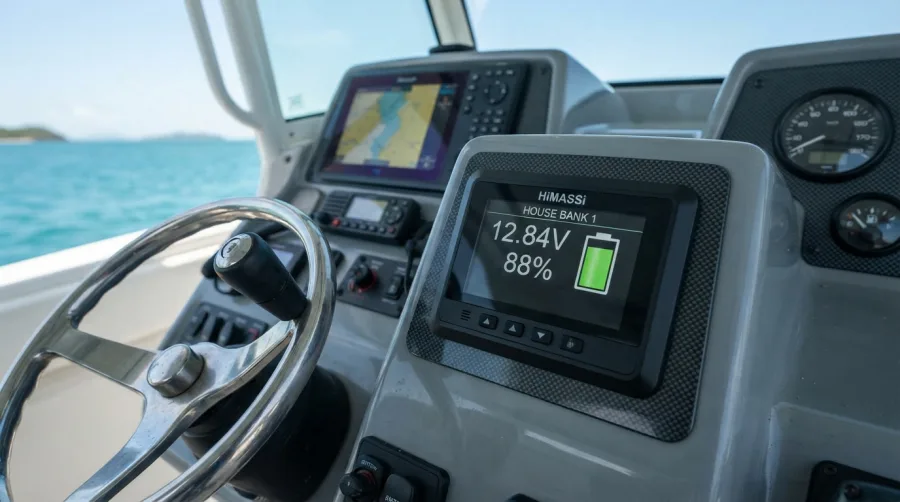
If you are selecting a battery for a boat, you can provide HiMASSi with your engine model, equipment power requirements, expected operating time, and existing charging configuration to discuss battery compatibility. Product applications, performance specifications, and installation requirements should always be confirmed using the official technical documentation for the specific battery model.