
Commercial Disclosure: The HiMASSi® Editorial Team combines local Australian market insight with the battery engineering and manufacturing expertise of Shenzhen Himax Electronics Co., Ltd. to provide practical, technically informed content for businesses, OEMs, system integrators, and industry professionals. As Himax Electronics’ official flagship brand in Australia, HiMASSi® focuses on LiFePO4 batteries, custom battery solutions, BMS technology, charging systems, battery selection, and application-specific power solutions. Our content covers technical guidance, industrial and commercial applications, product updates, and HiMASSi® news. All content reflects HiMASSi®’s official editorial perspective and is intended to help Australian customers evaluate battery solutions based on their application requirements, operating conditions, system compatibility, and project needs.
Key Takeaways
- Solar street light battery selection should be based on the installation location, monthly solar availability, and actual lighting schedule rather than simply copying a configuration used in another region.
- Battery capacity should account for nightly energy consumption, backup requirements during consecutive periods of low solar input, allowable depth of discharge, and capacity degradation over the battery’s service life.
- LiFePO4 can be considered as a battery option, but the specific product’s temperature range, BMS protection, and controller compatibility still need to be verified.
- Increasing battery capacity cannot solve persistent undercharging. The solar panel and battery need to be sized together to achieve an appropriate energy balance.
- For remote projects, transport, on-site maintenance, fault diagnosis, and spare-part replacement should all be included when evaluating procurement costs.
Introduction
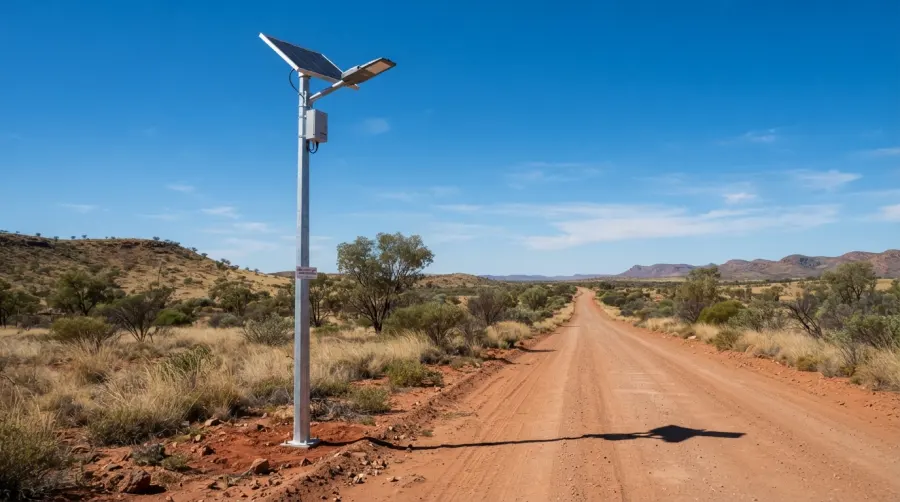
In remote roads, regional towns, farm access routes, and public parking areas across Australia, solar street lights can reduce reliance on grid connections. However, keeping the lighting system operating according to plan requires more than simply comparing light wattage and battery amp-hours.
From a battery manufacturing perspective, the right solar street light battery should be matched to local solar resources, lighting loads, ambient temperatures, and maintenance conditions. Undersizing may result in shorter lighting times, while an unbalanced configuration can increase costs without improving system performance.
Start With the Installation Site, Not Just the Idea That “Australia Gets Plenty of Sun”
Climate and seasonal conditions vary significantly across Australia. The same solar street light configuration should not be applied to every location without a site-specific assessment.
The Australian Bureau of Meteorology provides monthly, seasonal, and annual average daily solar exposure data, which can be used as a starting point for assessing solar resources at a project site. Annual averages are useful for understanding overall conditions, but they cannot by themselves demonstrate that a system will operate through consecutive periods of low solar input. Reference: Australian Bureau of Meteorology Solar Exposure Maps
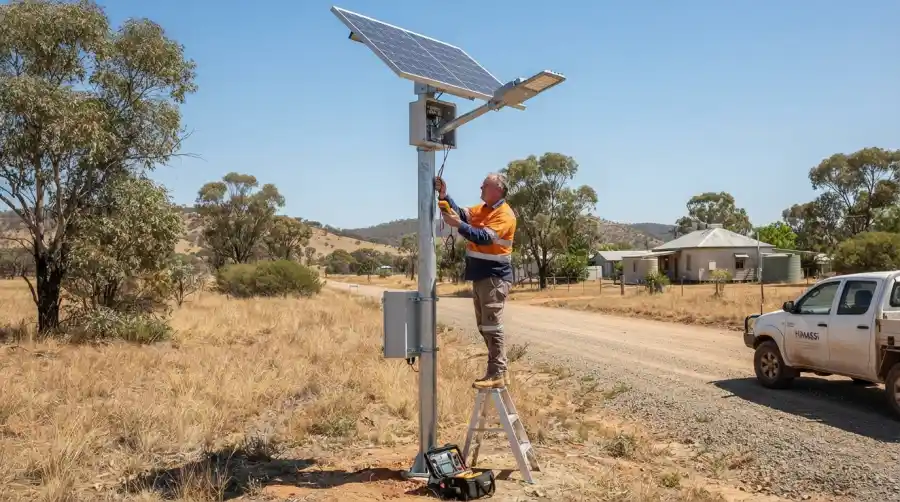
When selecting a system, it is useful to develop a requirements table based on actual site conditions:
| Site Condition | Potential Impact on the System | Information to Confirm |
| Hot inland sites with strong solar exposure | Solar heating of the battery enclosure and dust accumulation affecting energy generation | Internal enclosure temperature, shading conditions, cleaning intervals |
| Northern sites affected by the wet season | Consecutive cloudy or rainy days can reduce solar energy input | Duration of low-solar periods, backup lighting requirements |
| Southern sites during winter | Longer lighting periods and changes in solar energy availability | Winter lighting hours, monthly energy-generation estimates |
| Elevated or frost-prone locations | Low temperatures may restrict battery charging | Cell temperature, low-temperature charging protection |
| Coastal locations | Salt spray and humidity may affect connections and enclosures | Corrosion-resistant materials, sealing, and condensation management |
| Sites located far from maintenance teams | Higher cost per service visit | Remote monitoring, spare parts, and replacement procedures |
These are site-assessment considerations, not general conclusions that apply uniformly to an entire state or region. Shading from trees, terrain, and buildings, as well as solar panel tilt and orientation, should also be assessed separately.
Calculate Lighting Energy Consumption Before Determining Battery Capacity
Solar street light battery capacity should not be estimated solely from the rated wattage of the light fixture. The calculation should account for actual input power, daily operating hours, the dimming schedule, and auxiliary loads such as controllers and communication modules.
For example, a project may use the following operating schedule:
The figures above are provided only as a calculation example. Power should be measured at a clearly defined point in the system. If the measured value already includes driver losses, those losses should not be added again later in the calculation.
Time-based dimming can reduce energy consumption, but lighting output after dimming still needs to meet the project’s requirements. Australian lighting industry guidance on solar lighting also emphasises that system configuration should begin with the actual lighting requirements.
How Do You Calculate Solar Street Light Battery Capacity?
Once daily load consumption has been estimated, the following relationship can be used for preliminary battery sizing:
Rated Battery Energy ≈ Daily Load Energy Consumption × Backup Days ÷ (Allowable Usage Ratio × Power Delivery Efficiency × End-of-Life Capacity Retention Factor)
Assume:
- Daily load energy consumption is 240Wh;
- The system is designed for 3 consecutive days without meaningful supplemental charging;
- 80% of the battery’s rated capacity is allowed to be used;
- Power delivery efficiency from the battery to the load is estimated at 90%;
- The system is designed around retaining 80% of initial battery capacity at the end of its service life.
Then:
Rated Battery Energy ≈ 240 × 3 ÷ (0.8 × 0.9 × 0.8) ≈ 1,250Wh
If a battery pack with a nominal voltage of 25.6V is used:
Rated Capacity ≈ 1,250 ÷ 25.6 ≈ 48.8Ah
This result can be used as a starting point for selecting a candidate battery capacity, but it should not be treated as the final delivery specification. The effects of temperature on usable capacity, BMS cutoff conditions, manufacturing tolerances, and actual site operating conditions still need to be evaluated.
The “3 days of backup” in this example is an energy-design target under defined assumptions, not a guarantee of runtime under all weather conditions. If a low-state-of-charge dimming mode is used, the technical documentation should specify lighting duration separately for normal and reduced-power modes.
LiFePO4, NMC Lithium-Ion, or Lead-Acid Batteries?
Battery chemistry should be compared based on installation space, weight, operating temperature, and maintenance requirements rather than selected by chemistry name alone.
| Battery Chemistry | Characteristics to Evaluate | Key Selection Considerations |
| LiFePO4 | Can be considered for cyclic energy-storage applications and offers certain advantages in thermal stability | Low-temperature charging limits, BMS, actual cycle-life conditions |
| NMC lithium-ion | Can be considered where weight and installation space are constrained | Temperature management, protection strategy, and mechanical protection |
| Lead-acid, including AGM or gel | Can be evaluated based on upfront cost and compatibility with existing systems | Weight, depth of discharge, high-temperature service life, and charge recovery |
These characteristics are not a substitute for data from the specific battery model. Cycle life should also be compared under defined depth of discharge, temperature, C-rate, and end-of-life capacity criteria rather than by looking only at the stated number of cycles.
For remote projects, heavier batteries may increase transport and installation costs. Battery options that require more frequent replacement may also increase future on-site service costs. For this reason, costs should be compared across the planned service period of the system.
Temperature Management: Focus on Cell Temperature, Not Just the Weather Forecast
Hot Locations: The Battery Enclosure May Be Hotter Than the Air
A battery installed inside a metal enclosure exposed to direct sunlight may reach temperatures above the surrounding air temperature. The manufacturer should assess shading, enclosure colour, insulation, and heat-dissipation paths based on the installation location, while also considering heat generated by the controller.
Sealing can help protect against dust and water ingress, but it can also make heat dissipation more difficult. Environmental protection and thermal management need to be designed together rather than simply increasing the level of sealing.
Cold Locations: Being Able to Discharge Does Not Mean the Battery Can Charge
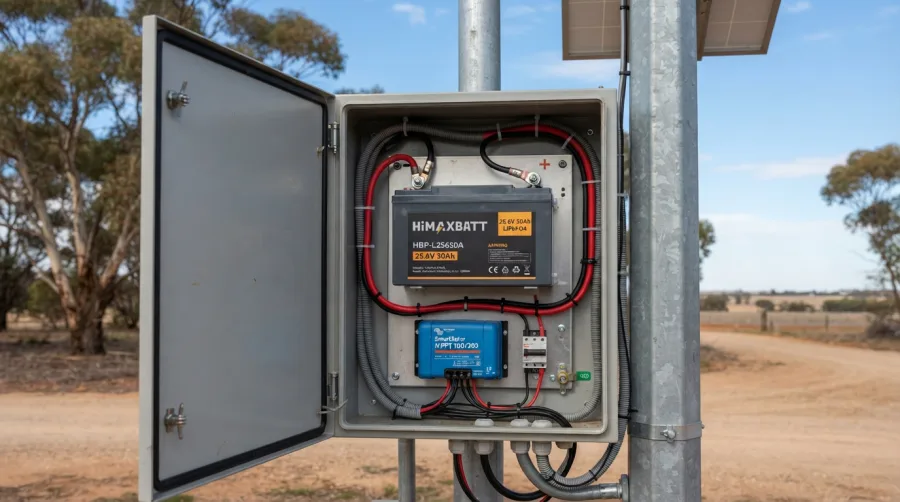
At some locations, solar input may begin early in the morning while the battery cells are still below their allowable charging temperature. In this situation, the controller or BMS should apply the appropriate charging restrictions.
For example, some Victron LiFePO4 battery products specify a charging temperature range of +5°C to +50°C. This applies to specific products and should not be treated as a universal operating range for all lithium batteries.
If the system includes battery heating, the energy consumed by the heater should be included in the energy budget, and the control logic for “heat first, then charge” should be verified.
If You Increase Battery Capacity, Can the Solar Panel Recharge It?
Increasing battery capacity can extend backup time, but it does not increase solar energy generation.
If a system consumes 240Wh per day but consistently replenishes only 180Wh, the battery’s state of charge will still decline over time. A larger battery will simply delay the point at which the system reaches a low state of charge.
Solar panel sizing should account not only for normal daily energy consumption but also for recovering energy after a low-solar period. For example, if the system accumulates a 720Wh energy deficit and is expected to recover it over the following 3 days, it needs to replenish approximately 240Wh per day in addition to the normal daily load, while also accounting for charging and conversion losses.
Parameters to check include:
- Solar resource at the actual panel orientation and any shading;
- Effects of panel temperature, dust accumulation, and ageing;
- Controller conversion efficiency and current limits;
- Allowable battery charging current;
- Target recovery time after the backup period.
Daylight hours should not be treated as equivalent to effective solar generation hours. Solar exposure data from the Australian Bureau of Meteorology represents accumulated daily solar energy and still needs to be converted into an energy-generation estimate appropriate for the specific PV installation. Reference: Australian Bureau of Meteorology Solar Radiation Glossary
The BMS and Solar Controller Need to Work Together
The BMS is primarily responsible for cell monitoring and protection, while the solar controller manages charging and loads. The two systems need to operate within compatible voltage, current, and temperature limits.
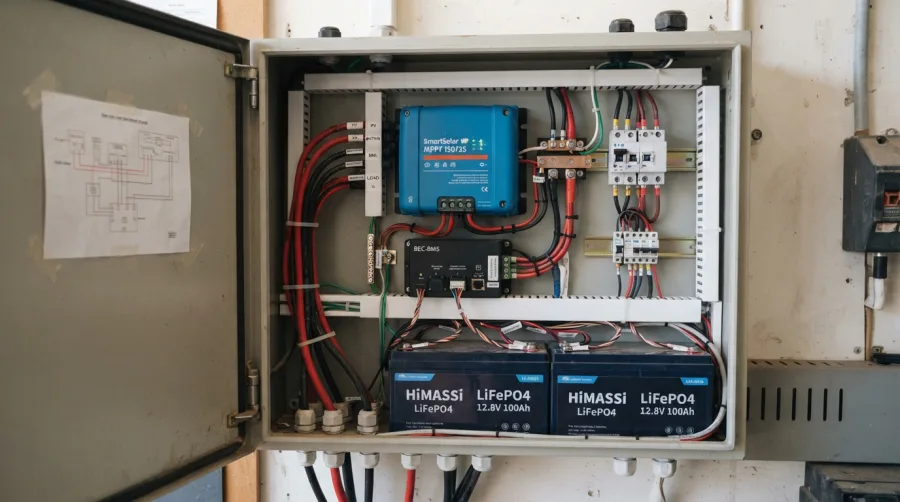
| Function | What to Verify |
| Charging settings | Compatible with the battery chemistry, series configuration, and manufacturer’s requirements |
| Temperature protection | Measures actual battery temperature and applies the permitted charging limits |
| Low-state-of-charge control | Adjusts lighting according to the agreed strategy before battery protection is triggered |
| Automatic recovery | Determines whether normal operation can resume when conditions return to an acceptable range |
| Quiescent power consumption | Cumulative energy consumption during extended periods of low solar input |
| Operating records | Availability of voltage, temperature, charging energy, and fault information |
The recovery process after a protection event is particularly important. If the controller cannot recognise the battery again after the BMS disconnects it, manual intervention may be required on-site, increasing the maintenance burden for remote projects.
How Should the System Be Verified From a Manufacturing and Procurement Perspective?
The requirement that a system be “suitable for remote areas of Australia” should be translated into technical requirements that can be verified.
The contract should also distinguish between design life, capacity degradation criteria, and warranty conditions. Laboratory cycle-life data should not be directly converted into expected years of service in the field.
FAQ: Choosing Solar Street Light Batteries in Australia
Is a Larger Solar Street Light Battery Always Better?
Increasing battery capacity can provide more stored energy, but it also increases weight, cost, and recharge recovery time. The battery should be sized together with the solar panel, controller, and load.
How Many Days of Cloudy or Rainy Weather Should the System Be Designed For?
There is no single number that applies to every location. The target should be based on local periods of consecutive low solar input, the importance of the lighting application, and the permitted dimming strategy, with the design assumptions clearly documented.
Does a High IP Rating Mean the Battery Is Suitable for Coastal Environments?
Not necessarily. Protection against dust and water ingress and resistance to salt-spray corrosion are different considerations. The enclosure, fasteners, connectors, and protective coatings should all be evaluated for the intended environment.
Is Remote Monitoring Still Useful in Areas Without Mobile Network Coverage?
Communication coverage should be confirmed first. Where a reliable network is unavailable, local data logging, on-site data retrieval, or other compatible communication methods may be considered. Communication-related energy consumption and maintenance costs should also be included in the system assessment.
What Information Should Be Provided When Requesting a Quote?
It is helpful to provide the installation coordinates, lighting schedule, measured power consumption, dimming strategy, required backup days, solar panel configuration, available installation space, and maintenance conditions. This information is much more useful for developing a practical solution than simply asking, “How many Ah do I need?”
About HiMASSi
HiMASSi is the official flagship brand of Shenzhen Himax Electronics Co., Ltd. in Australia. For solar street light projects in remote and regional Australia, you can provide HiMASSi with the installation location, lighting schedule, environmental conditions, and maintenance requirements to discuss a battery configuration suited to the project. Defining battery capacity, solar recharge capability, and on-site delivery requirements together helps establish a verifiable basis for selecting an off-grid lighting solution.