

Commercial Disclosure: The HiMASSi® Editorial Team combines local Australian market insight with the battery engineering and manufacturing expertise of Shenzhen Himax Electronics Co., Ltd. to provide practical, technically informed content for businesses, OEMs, system integrators, and industry professionals. As Himax Electronics’ official flagship brand in Australia, HiMASSi® focuses on LiFePO4 batteries, custom battery solutions, BMS technology, charging systems, battery selection, and application-specific power solutions. Our content covers technical guidance, industrial and commercial applications, product updates, and HiMASSi® news. All content reflects HiMASSi®’s official editorial perspective and is intended to help Australian customers evaluate battery solutions based on their application requirements, operating conditions, system compatibility, and project needs.
Key Takeaways
- Before your first spring ride, inspect the motorcycle battery case, mounting, terminal connections, and resting voltage.
- Resting voltage can indicate the battery’s current state of charge, but it does not by itself represent battery capacity or starting capability.
- After long periods of storage, lead-acid batteries may lose charge through self-discharge and parasitic loads. Extended storage at a low state of charge can increase the risk of sulfation.
- AGM, maintenance-free lead-acid, and lithium batteries do not use exactly the same charging strategy, so the charger should be compatible with the battery chemistry.
- If a fully charged battery still cannot start the motorcycle reliably, or charging voltage is abnormal after the engine starts, check the vehicle’s charging system and parasitic current draw as well.
- When replacing a motorcycle battery, do not rely on physical dimensions alone. Verify rated voltage, capacity, terminal position, CCA, installation space, and the requirements in the motorcycle owner’s manual.
- Used lead-acid batteries contain lead and electrolyte and should be taken to an appropriate recycling facility rather than disposed of with regular household waste.
Introduction
As temperatures rise in spring, many motorcycles come out of winter storage and return to commuting, short trips, and weekend rides. Whether the engine starts reliably often depends on a component that is easy to overlook: the motorcycle battery. Cold-weather storage, prolonged undercharging, parasitic electrical loads, terminal corrosion, and incorrect charging methods can all reveal battery problems when the motorcycle is first used again in spring.
From a battery manufacturing and application perspective, spring battery maintenance should not begin only after the motorcycle refuses to start. By inspecting the battery’s physical condition, resting voltage, starting performance, and charging-system operation, riders can often identify potential problems earlier and reduce the risk of being unable to restart the motorcycle during a trip.
This guide covers inspection, charging, troubleshooting, and replacement of motorcycle batteries to help you prepare more systematically before your next ride.
Why Is It Important to Check Your Motorcycle Battery in Spring?
Many riders encounter the same situation: the motorcycle appeared fine when it was parked for winter, but when spring arrives, the instrument panel flickers, the horn sounds weak, the starter relay clicks, or the engine will not start at all. This is often caused by a combination of factors rather than a single problem.
First, batteries naturally self-discharge while in storage. For lead-acid batteries, ambient temperature, manufacturing condition, battery age, and storage conditions can all affect the self-discharge rate. Second, modern motorcycles may continue drawing small amounts of power even when switched off through systems such as alarms, clocks, and ECU memory. If the motorcycle remains parked for several weeks or longer, a battery that was already partially discharged can fall to an even lower state of charge.
Battery University’s publicly available information notes that batteries gradually self-discharge during storage. For a 12V lead-acid battery, a resting voltage of around 12.42V can be treated as one indication that the battery may need attention and recharging. The actual threshold should still be evaluated according to the battery manufacturer’s instructions, ambient temperature, and measurement conditions. Battery University: Battery Storage and Recharging
From a battery manufacturing perspective, prolonged undercharging affects more than the next engine start. In a lead-acid starting battery, remaining at a low state of charge for an extended period can promote plate sulfation and reduce the ability of active materials to participate effectively in electrochemical reactions.
Even if the resting voltage later recovers, actual capacity and high-current starting capability may already have declined. Spring maintenance should therefore focus on inspection, recharging, and verification, rather than using one successful engine start as proof that the battery is healthy.
Before Your First Spring Ride: Complete These Four Basic Checks
Inspect the Battery and Its Installation
Switch off the ignition, remove the key, and make sure the motorcycle is stable before opening the battery compartment. Check the following:
- Look for swelling, cracks, deformation, electrolyte leakage, or visible signs of overheating on the battery case;
- Confirm that the battery is securely held by its strap or bracket and cannot move excessively during riding;
- Check the positive and negative terminals for looseness, oxidation, or white or blue-green corrosion;
- Inspect wiring insulation for ageing, cuts, or areas where it may be pinched against the frame;
- Check the battery compartment for standing water, dirt, or conductive contamination.
If the battery case is swollen, leaking, cracked, or the terminals show signs of severe heat damage, continuing to charge or use the battery is generally not recommended. When handling conventional lead-acid batteries containing liquid electrolyte, wear eye protection and acid-resistant gloves and avoid contact between electrolyte and your skin, clothing, or painted surfaces.
If the terminals show minor oxidation, clean the contact surfaces with the electrical system switched off and confirm that the connections are secure.
When disconnecting the battery, the negative terminal is generally removed first, followed by the positive terminal. During installation, connect the positive terminal first and the negative terminal last. This helps reduce the risk of an accidental short circuit if a tool contacts the motorcycle frame.
Measure Resting Voltage Instead of Testing Immediately After Riding
Resting voltage should be measured after the motorcycle has been switched off and allowed to sit for a period of time. Immediately after riding or charging, surface charge may temporarily raise the voltage reading, so it should not be used alone to determine battery health.
Set a digital multimeter to DC voltage, connect the red probe to the positive terminal and the black probe to the negative terminal. For a typical 12V lead-acid motorcycle starting battery, the following ranges can be used as an initial reference:
| Resting Voltage | Possible Condition | Recommended Spring Action |
| Around 12.7V or higher | Generally well charged | Check starting performance and terminal condition before normal use |
| 12.5V–12.6V | Usable state of charge, but not fully charged | If the motorcycle has been stored for a long period, consider charging with a compatible charger |
| 12.3V–12.4V | Low state of charge | Recharge with a smart charger and retest |
| 12.0V–12.2V | Significantly discharged | Check for parasitic current draw, then charge and test according to the manufacturer’s instructions |
| Below 12.0V | Increased risk of deep discharge | Do not rely solely on riding to recharge the battery; inspect the battery and vehicle charging system |
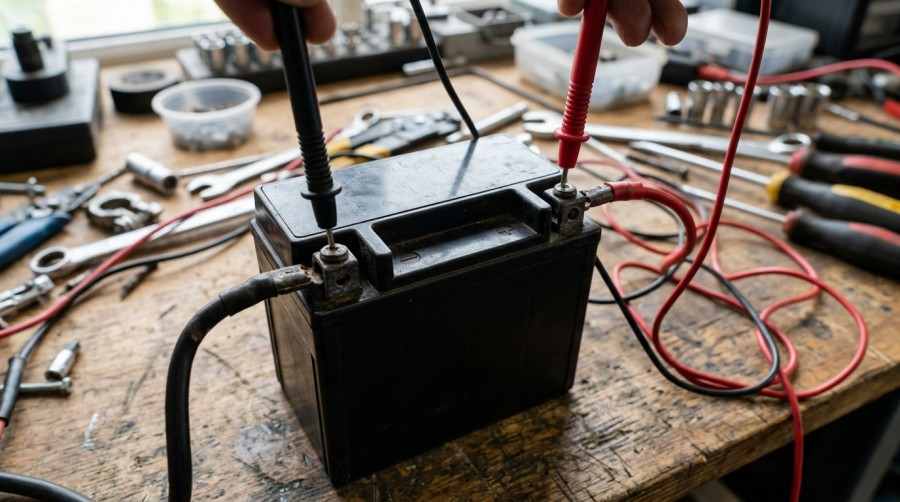
These values are general references for common lead-acid starting batteries at rest. They should not be applied directly to every lithium battery, 6V battery, or specialized motorcycle system.
Voltage provides only part of the picture. An ageing battery may show 12.6V with no load but experience a rapid voltage drop when the starter button is pressed, preventing it from delivering sufficient starting current.
Observe What Happens During Starting
A starting test is closer to real-world operation than a single resting-voltage measurement. After switching on the ignition, observe the instrument backlighting, turn signals, horn, and fuel-pump priming. When you press the starter button, note whether the engine cranks strongly and whether the instrument panel dims significantly or restarts.
| Symptom | Possible Cause | What to Check |
| Starter motor turns slowly | Low battery charge, increased internal resistance, poor terminal connection | Recharge and retest; inspect terminals and ground cable |
| Only the starter relay clicks | Battery cannot provide enough starting current or there is a connection problem | Measure voltage drop during starting and inspect wiring and battery condition |
| Instrument panel repeatedly restarts | Significant voltage drop during cranking | Check battery capacity, terminals, and starting circuit |
| Motorcycle starts after charging but battery is flat again after a few days | High battery self-discharge or parasitic vehicle load | Perform a parasitic-current test and inspect the electrical system if necessary |
| Motorcycle remains difficult to start after riding | Insufficient charging-system output or battery ageing | Check regulator/rectifier, stator, and charging voltage |
If possible, measure the battery voltage during cranking. There is no single voltage threshold that applies to every motorcycle because requirements vary by model, temperature, and starting system.
However, if voltage drops rapidly and significantly while the engine cranks weakly, the battery’s capacity, terminal resistance, and wiring connections should be investigated further.
Check the Charging System While the Motorcycle Is Running
A motorcycle battery is not maintained solely by an external charger. Once the engine is running, the stator, regulator/rectifier, and wiring work together to power the electrical system and recharge the battery.
Even a new battery may repeatedly discharge if the motorcycle’s charging system is not operating correctly.
Battery terminal voltage can be measured while the engine is running and the engine speed is moderately increased. On many 12V motorcycles, voltage under normal operating conditions should rise above the resting voltage measured with the engine switched off. The manufacturer’s service manual should always be used to determine the correct voltage range for the specific motorcycle.
If voltage does not increase, remains unusually low as engine speed rises, or becomes excessively high, do not assume that replacing the battery will solve the problem. Further inspection of the regulator/rectifier, stator, ground connections, fuses, and electrical connectors may be required.
How Should You Charge a Motorcycle Battery in Spring?
Identify the Battery Type First
A “12V motorcycle battery” does not mean that every battery uses the same charging method.
Common products include conventional flooded lead-acid batteries, maintenance-free lead-acid batteries, AGM batteries, gel batteries, and LiFePO4 starting batteries equipped with a BMS. These technologies can differ in charging voltage, temperature limits, float-charging requirements, and protection logic.
| Battery Type | Common Characteristics | Spring Charging Considerations |
| Flooded lead-acid battery | Usually includes filler caps or electrolyte-level indicators | Check electrolyte level and charge in a ventilated area away from sparks |
| AGM/maintenance-free lead-acid battery | Commonly sealed and generally more resistant to vibration | Use a smart charger designed for AGM/lead-acid batteries |
| Gel battery | More sensitive to charging voltage | Follow the battery label or manual and avoid incompatible fast-charging modes |
| LiFePO4 starting battery | Lightweight and commonly equipped with a BMS | Confirm that the charger supports the chemistry and follow low-temperature charging requirements |
Battery University’s information on charging explains that lead-acid batteries are commonly maintained with float charging after reaching full charge to compensate for self-discharge, while lithium-based batteries use a different maintenance-charging approach.
Therefore, a conventional lead-acid battery maintainer should not automatically be used long term with a lithium battery, nor should a lithium charging mode be used for a lead-acid battery. Battery University: Charging Differences Between Lithium and Lead-Acid Batteries
Recommended Charging Procedure
- Read the motorcycle and battery manuals to confirm battery chemistry, rated voltage, recommended charging current, and safety requirements.
- Charge in a dry, well-ventilated area away from flames and ignition sources. Avoid charging in enclosed storage spaces, near the fuel tank, or next to flammable materials.
- Switch off the motorcycle ignition. If the charger or vehicle instructions require battery removal, disconnect the negative terminal first, followed by the positive terminal.
- Connect the charger clamps to the battery before connecting AC power: red to positive and black to negative.
- Select the charging mode that matches the battery chemistry. For smaller motorcycle batteries, a moderate charging current can help limit temperature rise, but the actual charging current should follow the battery manufacturer’s specifications.
- When charging is complete, disconnect AC power first and then remove the charging clamps. Allow the battery to rest before measuring voltage and testing starting performance again.
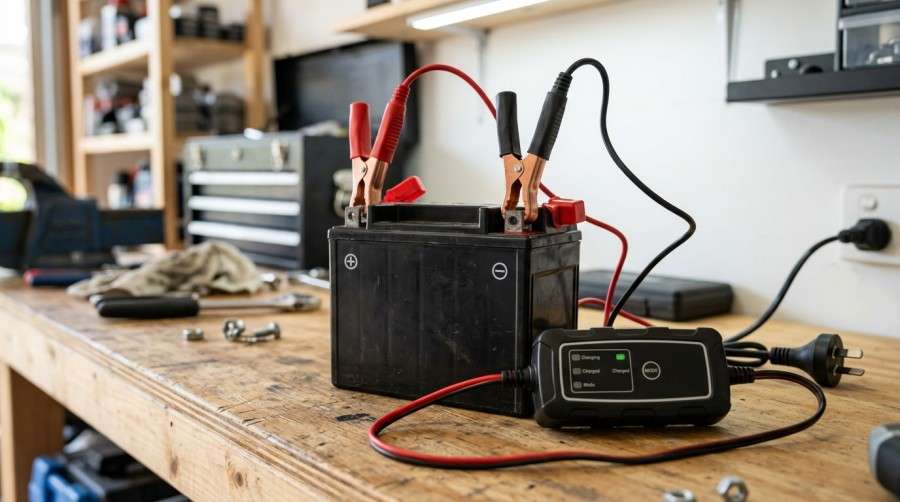
Avoid using high-current charging equipment of unknown origin or chargers without appropriate automatic control and protection for extended charging of small motorcycle batteries.
Excessive charging current, incorrect charging modes, overcharging, reversed polarity, or charging at excessively high temperatures can cause water loss, case deformation, internal damage, or other safety risks.
Also, “going for a ride to charge the battery” is not always a reliable way to recover a deeply discharged battery. During short, low-speed trips, the motorcycle’s charging system must first supply ignition, lighting, fuel injection, and other electrical loads. The amount of energy available to recharge the battery may therefore be limited.
If the battery is significantly discharged, using a compatible external smart charger followed by appropriate testing usually makes it easier to determine whether the underlying problem has been resolved.
When Might a Motorcycle Battery Need to Be Replaced?
Battery replacement should be determined by considering battery age, resting voltage after charging, starting performance, charge retention, and physical condition rather than purchase date alone.
Pay particular attention to the following conditions:
- The battery case is swollen, leaking, cracked, or the terminals are severely heat-damaged;
- Voltage drops quickly after the battery has been fully charged and allowed to rest;
- The charger indicates that charging is complete, but the engine still cranks noticeably weakly;
- The motorcycle charging system is operating normally, but the battery repeatedly becomes discharged;
- The battery has been in service for an extended period and no longer provides sufficient capacity or cold-cranking performance for the motorcycle;
- The battery has experienced repeated deep discharges and continues to perform inconsistently;
- A lithium battery’s BMS repeatedly triggers protection and cannot recover according to the product instructions, or the battery shows signs of physical damage.
Battery failure and charging-system faults can sometimes produce similar symptoms. For example, a battery that repeatedly goes flat may have lost capacity, but the problem could also be insufficient regulator/rectifier output or excessive parasitic current draw while the motorcycle is parked.
If these other causes are not identified and corrected, a new battery may also become discharged within a relatively short period.
Replacing a Motorcycle Battery: The Correct Model Matters More Than Whether It Fits
When choosing a replacement battery, use the motorcycle owner’s manual, original battery label, and actual battery compartment as your starting points.
A battery with greater capacity, higher CCA, or larger physical dimensions is not automatically suitable for every motorcycle. Battery compatibility also depends on the electrical system, cable length, mounting structure, terminal orientation, and charging strategy.
| Item to Verify | Why It Matters | Common Mistake |
| Rated voltage | Must match the motorcycle’s electrical system | Mixing 6V and 12V batteries |
| Capacity (Ah) | Affects stored energy and load-support capability | Choosing higher capacity without considering installation and charging compatibility |
| CCA/starting capability | Affects starting performance in cold weather and high-resistance conditions | Looking only at Ah while ignoring starting requirements |
| Physical dimensions | Determines whether the battery fits securely in the compartment | Battery remains loose or the hold-down bracket cannot be installed |
| Terminal position and polarity | Determines whether cables can be connected safely | Incorrect polarity orientation causes cable strain or short-circuit risk |
| Battery type | Affects charger and vehicle compatibility | Maintaining the battery with an incompatible charging mode |
| Venting and installation orientation | Particularly important for flooded batteries | Ignoring vent tubing or installation-angle restrictions |
Battery replacement can generally follow this sequence:
- Switch off the ignition, remove the key, and confirm that vehicle power is off.
- When removing the old battery, disconnect the negative terminal first and then the positive terminal.
- Clean the battery compartment, hold-down bracket, and terminal contact surfaces, and inspect the wiring for damage.
- Place the new battery into the compartment and confirm correct terminal orientation, cable length, and mounting position.
- Connect the positive terminal first and then the negative terminal. Tighten the fasteners securely without overtightening and damaging the terminals.
- Install the retaining strap or bracket and confirm that the battery cannot move under riding vibration.
- Switch on the motorcycle and check the instrument panel, then perform a starting test. If possible, also measure charging voltage while the engine is running.
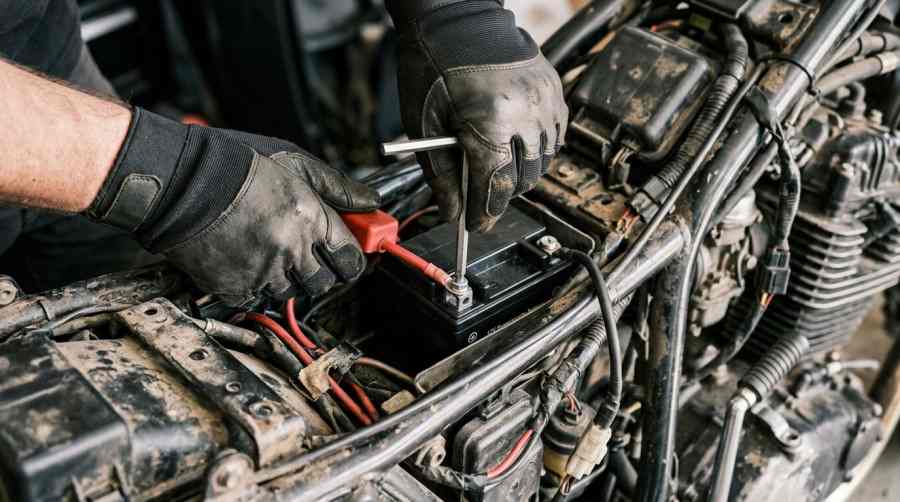
Used lead-acid batteries should not be discarded with ordinary waste. Australian government environmental guidance treats used lead-acid batteries as waste that presents environmental and safety risks and recommends recycling them through authorized or compliant channels. Australian Department of Climate Change, Energy, the Environment and Water: Used Lead-Acid Battery Recycling
Spring Storage and Routine Maintenance Tips
If you do not ride every day during spring, establish a simple maintenance routine. Check resting voltage, terminal condition, and signs of abnormal power consumption every two to four weeks. For longer storage periods, use a maintenance method appropriate for the battery type.
Lead-acid batteries should not remain at a low state of charge for extended periods. Lithium batteries should be stored and maintained according to the manufacturer’s requirements for state of charge, charging temperature, and maintenance charging.
Try to avoid the following habits:
- Leaving headlights, audio equipment, heated grips, or other significant loads running for extended periods after the engine is switched off;
- Starting the motorcycle repeatedly for short trips and then leaving it parked for long periods;
- Repeatedly jump-starting a discharged battery without properly recharging it or diagnosing the cause;
- Leaving a charger connected long term to a battery for which it is not designed;
- Allowing a metal tool to contact both battery terminals simultaneously or allowing the positive terminal to contact the frame directly;
- Ignoring loose terminals, poor grounding, or overheating electrical connectors.
FAQ: Common Spring Motorcycle Battery Questions
Why Won’t My Motorcycle Start Even Though the Resting Battery Voltage Looks Normal?
Resting voltage primarily indicates the battery’s current state of charge. It does not fully represent capacity, internal resistance, or high-current output capability.
An ageing battery may show a normal voltage with no load but experience a rapid voltage drop when the starter motor operates. In this situation, check voltage drop during starting, terminal connections, ground cables, the starter relay, and the starter motor rather than relying only on the voltmeter reading.
How Often Should a Motorcycle Battery Be Replaced?
There is no fixed replacement interval that applies to every motorcycle. Riding frequency, climate, charging-system condition, storage duration, battery type, and maintenance practices can all affect service life.
Rather than replacing the battery solely based on age, evaluate its ability to retain charge, starting performance, physical condition, and test results.
Can You Use a Car Battery Charger to Charge a Motorcycle Battery?
Only if the charger supports smaller motorcycle batteries, provides the correct mode for the battery chemistry, and offers appropriate current control.
Traditional high-current automotive chargers may not be suitable for smaller motorcycle batteries. Check both the charger instructions and battery specifications before use.
Are AGM Batteries and Conventional Lead-Acid Batteries Interchangeable?
Compatibility depends on the motorcycle manufacturer’s requirements, installation dimensions, terminal configuration, and charging-system characteristics.
AGM batteries and conventional flooded lead-acid batteries differ in construction and maintenance requirements, so compatibility should not be assumed simply because both are rated at 12V. Confirm vehicle compatibility and the correct charger mode before making a substitution.
Why Does a New Motorcycle Battery Keep Going Flat?
Possible causes include abnormal regulator/rectifier output, stator failure, poor grounding, corroded wiring, excessive parasitic current draw while parked, or incorrect activation, charging, or installation of the new battery.
In this situation, test the motorcycle’s charging voltage and parasitic current draw rather than assuming the new battery is defective.
About HiMASSi
HiMASSi is an official flagship brand developed by Shenzhen Himax Electronics Co., Ltd. for the Australian market, with a focus on motorcycle batteries and related power applications. The brand focuses on manufacturing consistency, vehicle compatibility, and reliable performance under real-world operating conditions, while providing riders with clearer guidance on battery selection, installation, and maintenance.
Whether you are preparing your motorcycle for the first spring ride, commuting regularly, or planning a weekend trip, check the motorcycle owner’s manual, battery specifications, and charging requirements before selecting or using a motorcycle battery.
Regular inspection, correct charging practices, and responsible battery recycling can help ensure that every ride begins with better preparation.