
Commercial Disclosure: The HiMASSi® Editorial Team combines local Australian market insight with the battery engineering and manufacturing expertise of Shenzhen Himax Electronics Co., Ltd. to provide practical, technically informed content for businesses, OEMs, system integrators, and industry professionals. As Himax Electronics’ official flagship brand in Australia, HiMASSi® focuses on LiFePO4 batteries, custom battery solutions, BMS technology, charging systems, battery selection, and application-specific power solutions. Our content covers technical guidance, industrial and commercial applications, product updates, and HiMASSi® news. All content reflects HiMASSi®’s official editorial perspective and is intended to help Australian customers evaluate battery solutions based on their application requirements, operating conditions, system compatibility, and project needs.
Key Takeaways
- When buying batteries in Australia, online shopping is useful for comparing specifications, prices, and technical information in advance, while local battery stores may be more suitable if you need on-site testing, installation assistance, or an urgent replacement.
- Battery suitability depends on chemistry, voltage, capacity, discharge capability, and charging compatibility. Quality should not be judged solely by where the battery is purchased.
- When comparing costs, consider shipping, installation, accessories, old-battery disposal, and potential after-sales transport expenses.
- Car starting batteries, caravan house batteries, and solar energy storage batteries have different selection priorities and should be evaluated according to their intended applications.
- Before placing an order, confirm the seller’s identity, stock location, delivery restrictions, and after-sales process to reduce the risk of ordering the wrong battery or experiencing unexpected delivery delays.
Introduction
Whether you are replacing a car starting battery or choosing a deep-cycle battery for a caravan or camping setup in Australia, one practical question often comes up: should you buy the battery online or visit a local battery store?
From a battery manufacturing perspective, the purchasing channel is only one part of the process. What matters more is whether the battery is compatible with your equipment, whether its specifications are supported by appropriate technical information, and whether clear technical support is available after purchase.
Understanding these factors can help you determine which purchasing option better suits your needs.
What Are the Differences Between Buying Batteries Online and From Local Stores in Australia?
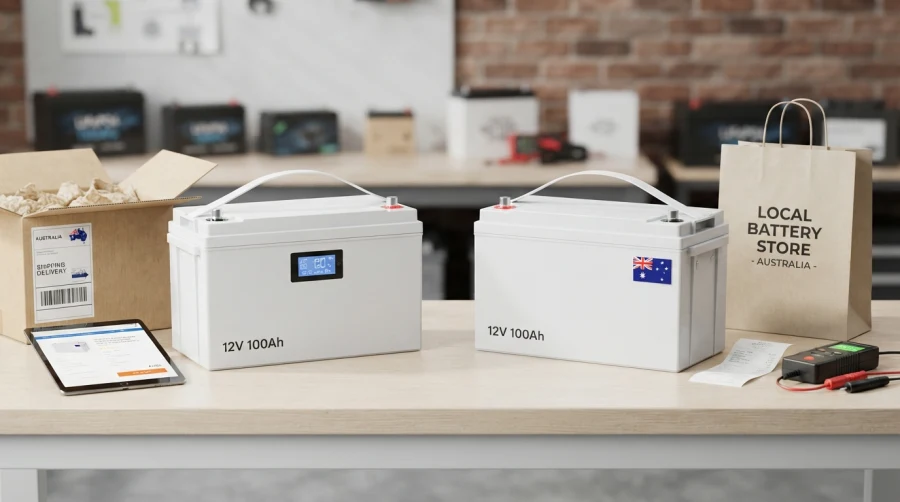
The following comparison is intended to help with purchasing decisions. Actual prices, stock availability, and services should always be confirmed with the individual seller.
| Comparison | Buying Batteries Online | Local Battery Stores |
| Specification comparison | Easy to compare specifications, datasheets, and prices across different models | In-person advice may be available, but the models you can compare may depend on store inventory |
| Delivery time | Depends on warehouse location, delivery address, carrier, and stock availability | In-stock batteries may be available for quick collection, although installation may still require an appointment |
| Compatibility confirmation | Usually requires you to provide equipment model, dimensions, and existing system specifications | Some stores may be able to inspect the vehicle or equipment; confirm this service in advance |
| Cost structure | Shipping and installation costs may apply in addition to the battery price | Quotes may include testing or installation, or these services may be charged separately |
| After-sales support | Order and communication records are easy to retain, although the battery may need to be returned for testing | Convenient for face-to-face communication, but on-site resolution depends on the store’s capabilities |
| Remote-area purchasing | Check postcode coverage and possible remote-area surcharges | Consider the distance to the store and the time required for a return trip |
Online and offline purchasing can also be combined. For example, you might review technical specifications online first and then ask a local service provider to inspect the installation conditions.
If you use this approach, clarify in advance who is responsible for product sales, installation, and troubleshooting.
When Does Buying a Battery Online Make More Sense?
You Already Know Your Equipment Requirements and Battery Specifications
If you already know the required voltage, installation space, terminal orientation, and charging and discharging requirements, buying a battery online in Australia can make targeted comparisons easier.

However, batteries cannot be assumed to be interchangeable simply because they are both rated at 12V. Automotive starting batteries are designed to deliver high current for a short period, while deep-cycle batteries are intended for sustained power delivery and repeated cycling.
A caravan house battery used to power a refrigerator and lighting should not be treated as a replacement for a vehicle starting battery simply because the capacities appear similar.
When shopping online, consider preparing a photo of the existing battery label, the equipment model, and measurements of the installation space. This can reduce errors caused by selecting a battery based on appearance alone.
You Want to Review Technical Information Carefully
Online purchasing makes it easier to review specifications repeatedly, but you should still assess whether the available technical information is sufficiently detailed.
From a manufacturing and quality-control perspective, consider checking the following:
- Whether rated capacity includes the relevant test conditions.
- Whether continuous discharge current and short-duration peak current are listed separately.
- Whether cycle-life figures include depth of discharge, temperature, and capacity-retention conditions.
- Whether charging requirements, operating temperature range, and installation instructions are provided.
- Whether product labels, model numbers, batch numbers, or serial numbers support traceability.
For example, two batteries may both be rated at 100Ah, but their test conditions, permitted discharge range, and load capabilities may differ.
Capacity and cycle-life figures become more meaningful when these underlying conditions are considered together.
You Can Plan the Purchase in Advance
Planned battery replacements are generally better suited to online comparison. If the battery is needed for a trip or project, allow sufficient time for shipping, inspection after delivery, installation, and system testing.
An “Australian website,” “pricing in Australian dollars,” and “shipping from a local Australian warehouse” are three different pieces of information and should not be treated as interchangeable.
Before paying, confirm the actual dispatch location, whether the battery is currently in stock, and whether the stated delivery time is an estimate or a firm commitment.
When Does Buying From a Local Battery Store Make More Sense?
Your Vehicle Won’t Start and You Need On-Site Troubleshooting
A vehicle that will not start may have a battery problem, but the fault could also involve the alternator, battery terminals, or vehicle electrical system.
A local battery store with appropriate testing equipment may be able to help narrow down the cause.
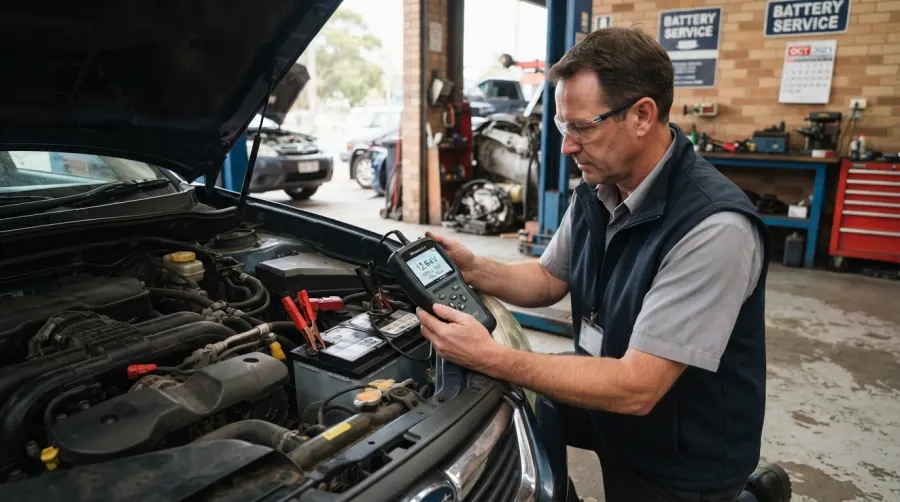
For automotive battery replacement in Australia, check not only battery dimensions and terminal position but also cold cranking amps (CCA) and whether the vehicle requires a particular battery technology such as AGM or EFB.
Some vehicles may also require battery management system registration or resetting after replacement. Check the vehicle manufacturer’s requirements and confirm whether the store provides the necessary service.
You’re Unsure Whether the Existing Charging System Is Compatible
When upgrading from a lead-acid battery to a LiFePO4 battery, installation dimensions are only one part of the compatibility assessment. Charging equipment, output voltage, current limits, and relevant protection settings should also be checked.
For example, Enerdrive’s lithium battery charger configuration guidance applies to specified product ranges and requires charging current to be considered alongside the battery specifications. This illustrates why charging settings should be based on documentation for the specific battery model rather than copied from another product.
If you are unsure whether an onboard charger, solar charge controller, or mains charger is compatible, having the system inspected by an experienced local service provider can be useful.
You Need Installation, Testing, or Old-Battery Disposal Services
The value of a physical battery store may include supporting services, but these services are not necessarily included in the battery price.
Before visiting, ask about the scope of installation, testing fees, appointment availability, and whether the store accepts your type of used battery for recycling or disposal.
Comparing Battery Prices: What Costs Should You Include?
When comparing battery prices in Australia, the following approach can be useful:
Actual Purchase Cost = Battery Price + Delivery Cost + Installation and Accessory Costs + Required System Modification Costs + Old-Battery Disposal Costs
Potential expenses associated with warranty returns, shipping, or additional store visits can be evaluated separately.
| Cost Item | Questions to Ask Before Buying |
| Battery price | Does the price include GST? Are you comparing the same model and configuration? |
| Delivery | Is your postcode covered? Are there remote-area surcharges? |
| Installation | Does it include removal, installation, testing, and any vehicle-specific registration or resetting? |
| Accessories | Will you need additional cables, fuses, terminals, or mounting brackets? |
| System modifications | Are your existing chargers and controllers compatible? |
| After-sales support | Who arranges testing and transport, and how are costs handled depending on the cause of the problem? |
A lower-priced battery may ultimately cost more if you need to replace charging equipment or purchase additional accessories.
Similarly, a higher quote from a physical store should be evaluated according to whether it includes services that you actually need.
Why Should You Confirm Lithium Battery Delivery and After-Sales Arrangements in Australia?
Shipping lithium batteries involves requirements related to battery type, energy rating, packaging, and transport method. Australia Post places specific restrictions on lithium battery shipments, so standard parcel delivery arrangements cannot automatically be applied to every battery. Reference: Australia Post Dangerous and Prohibited Items
For example, a battery rated at 12.8V and 100Ah has a nominal energy of approximately 1,280Wh when calculated by multiplying voltage by capacity.
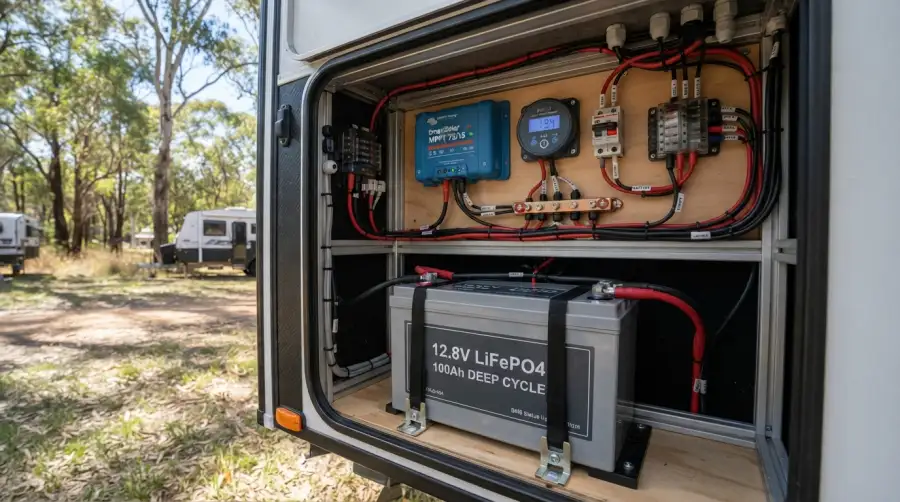
For a battery of this size, the seller should confirm the appropriate shipping arrangements. Before ordering, consider asking directly: “Can this battery be delivered to my postcode?” and “Who arranges transport if the battery needs to be returned?”
If a battery arrives with visible damage, deformation, or abnormal heating, stop installation and charging and contact the seller for instructions. Do not attempt to return it as an ordinary parcel without confirming the appropriate transport procedure.
For after-sales support, it is also important to distinguish between a seller’s commercial warranty, change-of-mind return policy, and consumer guarantees under Australian Consumer Law.
Where applicable, consumers do not lose their statutory protections simply because a purchase was made online, and a commercial warranty does not replace statutory rights. The specific remedy will depend on the transaction and the nature of the issue. Reference: ACCC Consumer Rights and Guarantees, ACCC Warranties
Which Purchasing Method Makes Sense for Different Applications?
| Application | Option to Consider First | Reason |
| Car suddenly won’t start | Local store with battery and vehicle testing capability | The fault needs to be diagnosed and vehicle compatibility confirmed |
| Planned replacement with a confirmed model | Compare and purchase online | Specifications are known and there is enough time for delivery |
| Upgrading a caravan from lead-acid to lithium | Research products online and combine this with professional installation assessment | Charging compatibility, wiring, and protection configuration must be considered |
| Battery for a camping refrigerator and lighting | Calculate loads before comparing purchasing channels | Energy consumption and required runtime should be determined first |
| Purchasing in a remote area | Compare delivery costs with the cost of travelling to a store | Postcode coverage, travel distance, and after-sales transport all matter |
| Bulk purchase for multiple devices | Confirm batch consistency, lead time, and support capabilities with the supplier | Consistency and traceability become more important |
Common Questions FAQ
Is It Reliable to Buy Batteries Online in Australia?
Reliability should be evaluated based on the seller’s identity, product documentation, transaction records, and after-sales arrangements.
Consider verifying the business name and ABN, specific product model, dispatch location, and contact information. Business registration information can help verify identity, but it should not be treated as a product quality certification.
Are Batteries Always Cheaper Online Than in Physical Stores?
Not necessarily.
Online prices may appear attractive, but delivery, installation, and accessories can change the total cost. Compare prices only after confirming that the battery model, configuration, and included services are equivalent.
Is Ah Capacity All That Matters When Buying a Deep-Cycle Battery for a Caravan?
No. Ah represents charge capacity, while Wh is also useful when comparing products with different voltages.
Actual runtime depends on the permitted discharge range, ambient temperature, load, and inverter losses. If the battery powers an inverter, you should also check its continuous discharge-current capability and the equipment’s startup or surge requirements.
Can a LiFePO4 Battery With a BMS Directly Replace My Existing Battery?
A BMS alone does not confirm compatibility.
A BMS monitors and protects the battery, but its functions and protection thresholds vary by model. Compatibility still depends on the application, charging system, installation environment, and output requirements. A BMS also does not replace properly designed cables and fuses required by the overall system.
Can Lithium Batteries With the Same Voltage and Capacity Be Connected in Series or Parallel?
This depends on the manufacturer’s instructions for the specific battery.
Confirm whether the manufacturer permits the intended connection method, how many batteries can be connected, and whether there are requirements for model matching and battery condition. Batteries should not be combined solely because the label specifications appear similar.
Is After-Sales Service Always Faster When You Buy From a Local Battery Store?
Not necessarily.
A physical store may make face-to-face communication easier, but processing time still depends on testing capability, replacement stock, and supplier procedures. An online seller with a clearly established local support process may also provide convenient service.
Understanding the actual after-sales process before purchasing is more useful than judging support based solely on the sales channel.
About HiMASSi
HiMASSi is an official flagship brand developed by Shenzhen Himax Electronics Co., Ltd. for the Australian market. We aim to help customers understand battery specifications, equipment compatibility, and operating requirements from both battery manufacturing and real-world application perspectives.
Whether you are comparing online battery suppliers in Australia or considering a local battery store, you can provide HiMASSi with your equipment model, existing battery specifications, and intended application to discuss product compatibility.
Product performance, delivery coverage, and warranty services should always be confirmed according to the specifications of the relevant battery model and the terms published on the official website.