
Commercial Disclosure: The HiMASSi® Editorial Team combines local Australian market insight with the battery engineering and manufacturing expertise of Shenzhen Himax Electronics Co., Ltd. to provide practical, technically informed content for businesses, OEMs, system integrators, and industry professionals. As Himax Electronics’ official flagship brand in Australia, HiMASSi® focuses on LiFePO4 batteries, custom battery solutions, BMS technology, charging systems, battery selection, and application-specific power solutions. Our content covers technical guidance, industrial and commercial applications, product updates, and HiMASSi® news. All content reflects HiMASSi®’s official editorial perspective and is intended to help Australian customers evaluate battery solutions based on their application requirements, operating conditions, system compatibility, and project needs.
Key Takeaways
- Before heading out on the water in spring, your battery inspection should cover its physical condition, state of charge, performance under load, and charging status.Dashboard lights turning on or the engine successfully starting once is not enough to confirm that the electrical system is in good condition.
- Starting batteries and house batteries serve different purposes and should be checked separately to prevent loads such as refrigerators and lighting from draining the power needed to start the engine.
- Flooded lead-acid, AGM, and LiFePO4 batteries require different maintenance practices. Watering, charging, and state-of-charge assessment methods are not interchangeable.
- Salt spray, moisture, and vibration can cause terminal corrosion, loose connections, and voltage drop in wiring, so the entire power circuit should be inspected.
- Bilge pumps, navigation lights, communication equipment, and navigation electronics should be tested individually, and backup power arrangements for critical equipment should be confirmed.
- If you find battery swelling, leakage, abnormal heating, burned or damaged cables, or repeated protection trips, troubleshoot the problem before heading out on the water.
Introduction
Spring in Australia typically runs from September through November. For boats that have been stored over winter or left unused for an extended period, an electrical inspection before relaunching can help identify undercharged batteries, corroded connections, and charging problems before they affect a trip.
From a battery manufacturing and application-matching perspective, the reliability of a marine battery depends on how well the battery itself, protection system, charging equipment, and onboard wiring work together. This guide covers these areas to help boat owners establish a clear spring inspection process.
Why Should You Recheck Your Battery After Your Boat Has Been in Storage?
A boat that is not being used does not necessarily have zero battery drain. Monitoring devices, alarms, battery management systems, and electronics left in standby mode may continue to draw power. Bilge pumps can also consume energy if they operate while the boat is docked or stored.
At the same time, moisture and salt can accelerate corrosion at electrical connections. Some problems may not be noticeable under light loads but can become apparent when starting the engine, operating a windlass, or running multiple devices at the same time.
The New South Wales Government identifies battery failure as one of the causes of powerboat breakdowns and advises boat owners to make sure their batteries can support repeated engine starts, as batteries may fail after extended periods of inactivity. Reference: NSW Vessel Maintenance Guide
For this reason, a spring marine battery inspection should include testing under actual operating conditions rather than relying only on open-circuit voltage.
Before You Start, Identify the Battery Type and Its Role in the Electrical System
Distinguish Between Starting Batteries and House Batteries
A starting battery is primarily designed to deliver high current for a short period when starting the engine. A house battery, also known as a service battery, is primarily used to provide continuous power for lighting, refrigerators, navigation electronics, and other onboard loads.
Some batteries are designed for dual-purpose use, but this should be clearly specified by the manufacturer. Two batteries with the same rated capacity do not necessarily have the same starting capability, continuous discharge performance, or protection strategy.
| Item to Check | Key Specifications | Problems to Watch For |
| Engine starting battery | Starting capability required by the engine, duration of starting current | Slow cranking, sudden voltage drop, electronics restarting |
| House battery | Usable energy, continuous output capability, actual capacity condition | Insufficient runtime at anchor, early low-battery cutoff |
| Dedicated windlass or thruster battery | Short-duration high-current capability, cable and connector specifications | Slow operation, hot connections, protection trips |
| Backup power supply | Remaining charge, switching method, electrical independence | Shared failure points with the main power source, inability to provide independent backup power |
Choose the Inspection Method Based on Battery Chemistry
| Battery Type | Key Spring Inspection Items | Practices to Avoid |
| Flooded lead-acid battery | Electrolyte level, ventilation, terminal condition, and load performance | Adding acid unnecessarily or overfilling with water |
| AGM and gel lead-acid batteries | Case condition, charging parameters, capacity, and starting performance | Opening the sealed case to add water |
| LiFePO4 battery | BMS records, temperature, cell condition, and charging compatibility | Using lead-acid repair modes or bypassing protection systems |
When a flooded lead-acid battery requires watering, use distilled water and maintain the level specified in the applicable manual. This maintenance procedure does not apply to sealed lead-acid or lithium batteries.
How Do You Inspect a Marine Battery and Its Connections?
Inspect the Battery Case, Mounting Hardware, and Installation Area
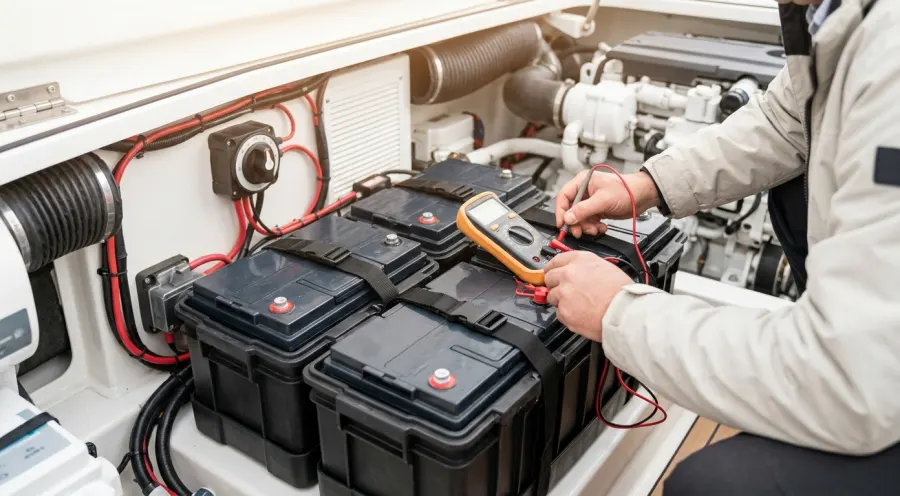
Check the battery for swelling, cracks, leaks, unusual discoloration, or signs of overheating. Inspect the mounting brackets, straps, and battery box to make sure the battery cannot move due to vessel motion or vibration.
The installation area should meet the battery manufacturer’s requirements and be protected from standing water, excessive heat, and mechanical pressure. Lead-acid batteries may release gases while charging and require appropriate ventilation. Lithium batteries should also have the installation clearance and thermal conditions specified by the manufacturer.
A water-resistant battery box does not mean the battery, connectors, and entire installation can withstand immersion. If seawater enters a battery or electrical equipment, stop further energized testing and have the system evaluated by a qualified professional.
Check for Terminal Corrosion and Loose Connections
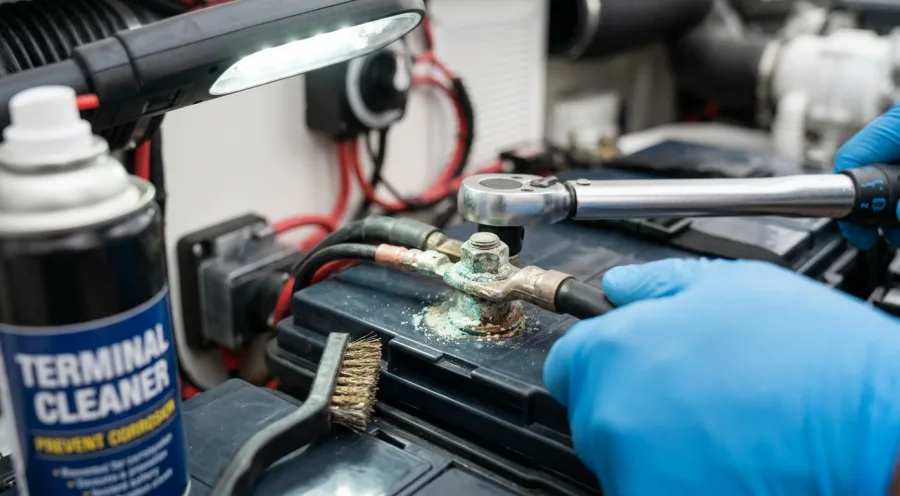
Inspect battery terminals, cable lugs, fuse holders, and busbars for white deposits, green corrosion, rust, or looseness.
Poor connections increase electrical resistance. When current flows through these points, voltage drop and localized heating can occur, making a battery that is otherwise in acceptable condition appear to be undercharged or weak.
Battery terminals should be tightened to the manufacturer’s specified torque. Overtightening can damage the terminal posts. If corrosion has migrated into the cable itself, cleaning only the exposed surface may not resolve the problem.
Before disconnecting or cleaning electrical connections, follow the vessel’s isolation procedures for batteries, shore power, solar systems, inverters, and other power sources. Do not assume that turning off a single master switch de-energizes every circuit. Automatic bilge pumps on docked vessels may still require power.
If the Marine Battery Voltage Looks Normal, Is the Boat Ready to Go?
No. Voltage primarily indicates battery condition under specific circumstances and, by itself, does not confirm available capacity or high-current output capability.
Recent charging, active loads, and changes in ambient temperature can all affect voltage readings. Different battery chemistries also require different methods for relating voltage to state of charge.
Open-Circuit Voltage Check: Use It as an Initial Screening Tool
Before measuring, stop charging and discharging as specified by the battery manufacturer and allow the battery to rest for the recommended period. Record the battery model, temperature, rest period, and measured voltage so the results can be compared over time.
LiFePO4 batteries have a relatively flat voltage profile across a broad state-of-charge range, so terminal voltage alone cannot accurately determine remaining charge. A properly configured battery monitor, BMS data, and operating records should also be considered.
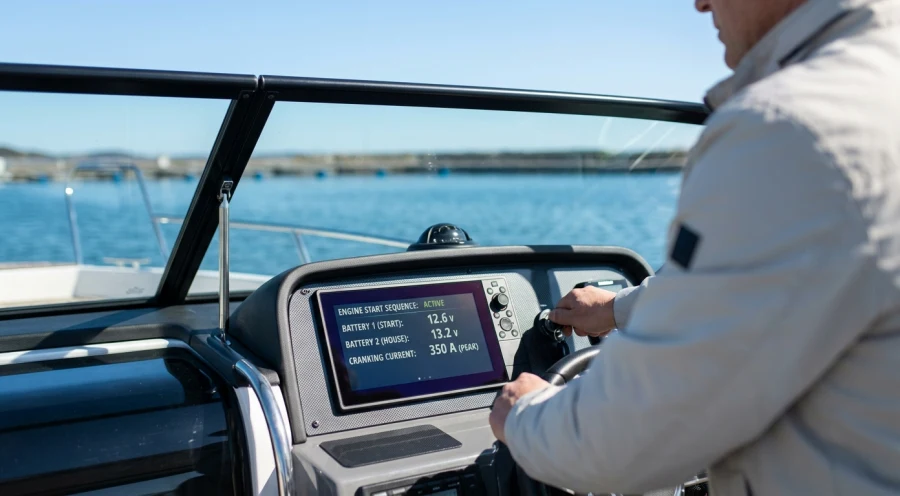
Starting or Load Test: Observe Actual Power Delivery
For a starting battery, evaluate voltage behavior and engine cranking performance according to the engine’s requirements. Testing should be performed under conditions that meet engine cooling, ventilation, and site-safety requirements. Follow the recommended intervals between starting attempts and avoid prolonged continuous cranking.
House batteries can be tested at the dock by turning on normal loads one at a time and watching for unusual voltage drops, device restarts, or BMS alarms.
Acceptable voltage during engine starting depends on battery type, temperature, and engine requirements, so a single voltage threshold should not be applied to every vessel. Lead-acid battery testers may also be unsuitable for lithium batteries, so instrument compatibility should be verified.
Capacity Test: Confirm Actual Available Runtime
If battery runtime has noticeably decreased even after a full charge, a controlled capacity test may be appropriate. The test should use specified current, temperature, and discharge cutoff conditions and should be performed by someone with the appropriate equipment and expertise. Do not test battery capacity by taking the boat out and simply running the battery until it shuts down.
Inspecting the Boat’s Electrical System: Follow the Power Circuit
Spring Boat Electrical Inspection Checklist
| Inspection Point | What to Check | What to Do If You Find a Problem | Estimated Energy Consumption |
| Positive and negative battery connections | Tightness, insulation, protective covers, corrosion | Repair connections to specification or replace damaged components | 108Wh |
| Main switches and distribution panels | Labels, operating condition, signs of overheating | Check for poor connections or internal damage | 36Wh |
| Fuses and circuit breakers | Rated voltage, current rating, type, and interrupting capacity | Verify compatibility with the power source and wiring | 180Wh |
| Cables and bulkhead penetrations | Abrasion, cracking, mounting, water intrusion, and strain | Repair wiring and address the source of abrasion or water intrusion | 324Wh |
| Negative circuits and busbars | Corrosion, looseness, abnormal shared connections | Inspect return paths and voltage drop under load | |
| Shore power inlet and cable | Discolored or burned plugs, damaged insulation, moisture | Stop using the affected shore power connection and arrange repairs | |
| Navigation lights and navigation equipment | Actual operation, brightness, and stability | Troubleshoot the equipment, connectors, and power supply | |
| Bilge pump and float switch | Automatic and manual operation, actual water discharge | Check the power supply, sensor, pump, and plumbing |
Fuse selection should account for cable protection, equipment startup characteristics, and available fault current. This is especially important when changing battery types. Do not simply reuse the original fuse amp rating without also checking its DC voltage rating and interrupting capacity. Victron’s DC wiring documentation provides technical guidance on cable voltage drop and fuse protection.
For shore power and inverter AC circuits, follow the equipment instructions for user-level visual inspections and test-button checks. Internal distribution-panel repairs, insulation testing, and protective-ground troubleshooting should be handled by qualified personnel.
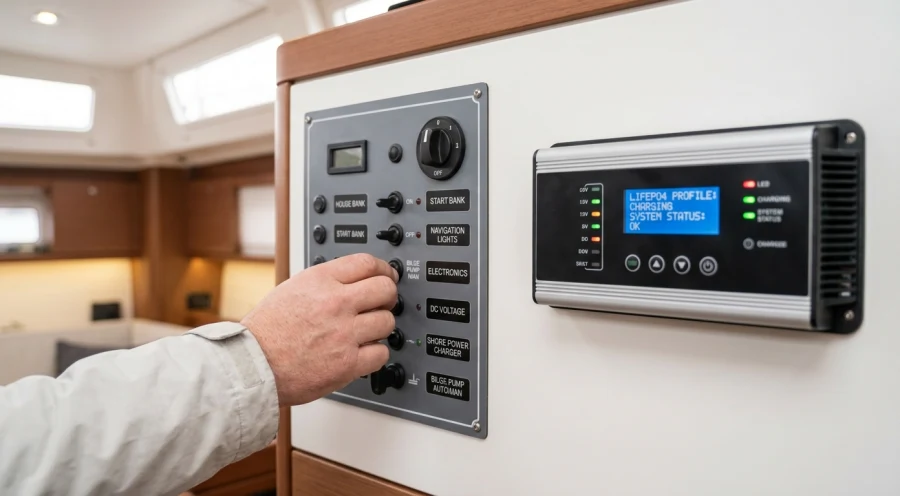
Don’t Forget the Charging System: Check the Engine, Shore Power, and Solar
A boat’s batteries may receive charging power from several sources. During inspection, confirm that each source operates correctly and is compatible with the battery specifications.
Engine Charging
Under conditions appropriate for engine operation, monitor charging voltage, current, and alarm status. For lithium battery systems, also verify the alternator’s continuous-output and thermal capabilities, as well as how the system responds if the BMS stops accepting charge.
Lithium batteries can have relatively high charge acceptance, which may keep an alternator under a higher load for an extended period. Some marine systems manage this load through controlled regulation or current-limited DC-DC chargers, but the appropriate configuration depends on the alternator and battery-system design.
Shore Power Charger
Verify the battery mode, charging voltage, current-limit settings, temperature sensors, and fault history. After switching to LiFePO4 batteries, confirm whether the original lead-acid charging profile is still appropriate, particularly any repair, equalization, or temperature-compensation functions.
Solar Charging
Inspect panel mounting, cables, and controller records, and confirm that the correct battery type is selected. A powered-on charge-controller display does not necessarily mean the battery is receiving meaningful charging current. Check actual current and charging status under the available sunlight conditions.
Test Critical Equipment and Plan Your Energy Reserve
Test Both Automatic and Manual Bilge Pump Operation
Hearing the pump motor run does not confirm that water is actually being discharged. Follow the equipment instructions to verify water-level activation, pump operation, and unrestricted discharge, while avoiding prolonged dry running.
Some automatic bilge pumps use an independently fused power supply that remains active regardless of the vessel’s normal master switch. Confirm the actual wiring design so the automatic pumping function is not accidentally disabled while the boat is docked. At the same time, do not bypass fuse protection simply to keep the pump powered.
Check Navigation Lights, Communications, and Navigation Electronics
Operate navigation lights, chart displays, depth instruments, and communication equipment individually, then observe whether any devices flicker or restart when several loads operate simultaneously. Communication testing should follow equipment instructions and local operating requirements. Do not transmit false distress signals.
Use an Energy Budget to Plan Runtime and Reserve Capacity
A preliminary estimate can be calculated as follows:
Device Energy Consumption (Wh) ≈ Power (W) × Total Operating Time (h)
For example, the following represents a hypothetical house-load profile:
| Device | Example Power | Total Operating Time | Estimated Energy Consumption |
| Navigation display | 18W | 6 hours | 108Wh |
| Lighting | 12W | 3 hours | 36Wh |
| Refrigerator | 45W | 4 hours of cumulative compressor operation | 180Wh |
| Total | — | — | 324Wh |
This is only a calculation example and does not include every possible onboard load. When selecting a battery, also account for conversion losses, battery aging, temperature, unexpected delays, and emergency power requirements, while preserving the energy required for engine starting. Batteries with different nominal voltages should not be compared using Ah alone.
Professional FAQ
Does a Marine Battery Need to Be Replaced After the Boat Has Been Stored for One Winter?
Not simply because it has been stored for one winter. Evaluate the battery based on its physical condition, charging history, open-circuit voltage, performance under load, and available capacity. If the battery shows swelling, leakage, or persistent abnormal behavior, stop using it and arrange an appropriate evaluation.
Why Won’t the Engine Start Even When the Marine Battery Shows a Full Charge?
Possible causes include loose terminals, excessive voltage drop in the cables, insufficient starting capability, BMS current limiting, or a problem with the starter motor or engine. A full-charge indication reflects estimated state of charge; it does not necessarily mean the battery can deliver the required starting current.
Can a LiFePO4 Deep-Cycle Battery Be Used as a Marine Starting Battery?
Capacity alone is not enough to determine suitability. The battery must be specifically designed or approved for engine starting and must meet the engine’s requirements for pulse current, pulse duration, low-temperature performance, and charging compatibility. The BMS in some deep-cycle lithium batteries may activate protection during the high-current starting event.
Why Are Marine Battery Terminals Still Getting Hot After Cleaning?
Possible causes include poor cable-lug crimping, improper terminal torque, internal corrosion, undersized cables, or excessive load. Stop operating the affected circuit and identify the cause. Do not install a higher-rated fuse simply to prevent the existing fuse from opening.
What Should You Check Before Every Trip After Completing a Spring Inspection?
Before each trip, you should still perform a quick check of battery state of charge, alarms, connections, bilge pump operation, and communication and navigation equipment. A seasonal inspection helps identify problems that develop over time, while a pre-departure inspection confirms the boat’s condition on the day of the trip. Safety equipment should also be checked according to the requirements for your state, vessel type, and operating waters. Reference: NSW Boating Safety Equipment Checklist
Start Your Spring Boating Preparation With Reliable Power
A boat battery and onboard electrical-system inspection should follow a complete process: visual inspection—condition assessment—load verification—charging-system inspection—critical equipment testing.
Keeping maintenance records that include the battery model, installation date, measurement conditions, alarm history, and repairs can make it easier to identify performance changes and help technicians diagnose problems. If a critical power-supply or drainage-system fault is found, complete the necessary repairs before planning your trip.
Learn About HiMASSi Marine Batteries
HiMASSi is the official flagship brand launched by Shenzhen Himax Electronics Co., Ltd. for the Australian market. For marine battery selection and onboard power-system applications, we focus on matching battery performance, charging compatibility, and real-world operating conditions. If you are planning a marine battery replacement or an onboard power-system upgrade, you can provide HiMASSi with your vessel type, engine requirements, existing charging equipment, and typical onboard loads to discuss a battery solution suited to your project’s requirements.