
Commercial Disclosure: The HiMASSi® Editorial Team combines local Australian market insight with the battery engineering and manufacturing expertise of Shenzhen Himax Electronics Co., Ltd. to provide practical, technically informed content for businesses, OEMs, system integrators, and industry professionals. As Himax Electronics’ official flagship brand in Australia, HiMASSi® focuses on LiFePO4 batteries, custom battery solutions, BMS technology, charging systems, battery selection, and application-specific power solutions. Our content covers technical guidance, industrial and commercial applications, product updates, and HiMASSi® news. All content reflects HiMASSi®’s official editorial perspective and is intended to help Australian customers evaluate battery solutions based on their application requirements, operating conditions, system compatibility, and project needs.
Key Takeaways
- When choosing a golf cart battery, first confirm the vehicle model, system voltage and controller requirements before comparing capacity and price.
- For users in Brisbane and the Gold Coast, high temperatures, rainfall and potential salt exposure in coastal locations should be considered when assessing battery protection, installation and maintenance requirements.
- Driving range should not be assessed by amp-hours (Ah) alone. Nominal energy, usable depth of discharge, payload, gradients and actual driving routes all need to be considered.
- When upgrading from lead-acid to LiFePO4 batteries, check the charger, BMS, mounting hardware, battery gauge and accessory power supply at the same time.
- When comparing quotes, include the battery, supporting components, installation, freight and after-sales terms in the same checklist.
Introduction
Whether a golf cart is used for everyday rounds on a Brisbane golf course or for guest transport at a Gold Coast resort, its battery needs to suit both the vehicle and the way it is used. A higher-capacity battery does not automatically mean greater driving range, and upgrading to lithium does not necessarily mean every component from the original battery system can continue to be used unchanged.
This Brisbane and Gold Coast golf cart battery buying guide looks at battery selection from a manufacturing and system compatibility perspective, helping golf cart owners, course operators and procurement teams understand the key factors to consider.
How Do Local Conditions Affect Golf Cart Battery Selection?
Hot Weather: Consider the Battery Compartment, Not Just the Forecast
Long-term climate statistics for Brisbane from the Australian Bureau of Meteorology can provide useful context for seasonal temperature and rainfall patterns. However, the recorded outdoor temperature is not necessarily the same as the temperature inside a golf cart’s battery compartment. Reference: Australian Bureau of Meteorology – Brisbane Climate Statistics
Parking a vehicle in direct sunlight, sustained hill climbing and heat generated during charging can all affect the battery’s actual operating conditions. When sourcing a battery, ask the supplier for its specified charging, discharging and storage temperature ranges, as well as what happens when temperature protection is triggered.
For golf carts used frequently throughout the day, it is also worth providing the supplier with details about daily operating hours and whether charging takes place in a shaded, well-ventilated area. This information can help the supplier assess the appropriate battery configuration.
Rain and Coastal Salt Exposure: Check Both the Enclosure and Connections
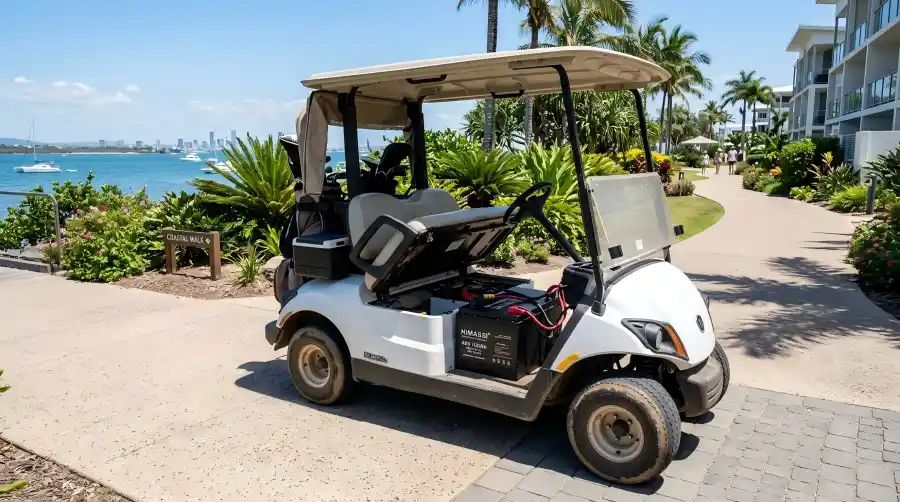
For golf carts operating near the coast on the Gold Coast, particular attention should be paid to corrosion around terminals, cable connections and metal mounting hardware. A sealed lithium battery enclosure does not mean external connections are maintenance-free. Moisture and salt exposure can still affect these components.
If a battery has an IP rating, check whether that rating applies to the battery enclosure, connectors or the complete installed assembly. An IP rating should not be treated as evidence of salt-spray resistance, nor should it be used to assume that the vehicle can be driven through water or cleaned with a high-pressure washer.
Check Your Golf Cart Specifications Before Choosing a Battery
Before purchasing the golf cart batteries in Brisbane or arranging a golf cart battery replacement on the Gold Coast, it is a good idea to photograph the vehicle identification plate, existing battery labels, charger label and battery compartment.
| Item to Check | Information to Provide or Confirm | Why It Matters |
| Vehicle details | Make, model, year and modification history | Different models from the same manufacturer may use different configurations |
| System voltage | Original nominal voltage and controller operating range | Determines whether the battery system is compatible |
| Existing battery configuration | Voltage per battery, quantity, and series/parallel configuration | Helps identify the vehicle’s existing power architecture |
| Installation space | Battery compartment dimensions, mounting points and terminal locations | Determines whether the battery can be securely installed and correctly wired |
| Operating load | Passengers, cargo, gradients and frequency of starts and stops | Affects continuous and short-duration current requirements |
| Charging conditions | Charger model, output specifications and available charging time | Determines charging compatibility and operating schedules |
| Onboard accessories | Lights, audio systems and other low-voltage equipment | A suitable DC-DC converter may be required |
For example, six 8V batteries connected in series provide a nominal total of 48V, but that does not mean any lithium battery labelled “48V” can be used as a direct replacement. The full-charge voltage, low-voltage protection thresholds, controller requirements and charger compatibility still need to be checked.
How Do Lead-Acid and LiFePO4 Golf Cart Batteries Compare?
Golf carts are traction applications that undergo repeated charge and discharge cycles. The battery should therefore be suitable for the required deep-cycle or traction duty. An automotive starting battery should not be selected simply because its physical dimensions and voltage appear suitable.
| Comparison | Flooded Deep-Cycle Lead-Acid | AGM Deep-Cycle Lead-Acid | LiFePO4 Battery |
| Upfront cost | Typically lower, but the complete battery bank configuration should be considered | Typically higher than comparable flooded products | Typically higher, with conversion components potentially adding to the total cost |
| Routine maintenance | Electrolyte levels need to be checked and topped up according to manufacturer instructions | Usually does not require topping up, but connections still need inspection | No topping up required, but mounting, connections and warning conditions should still be checked |
| Weight | Typically heavier for the same nominal energy | Typically heavier for the same nominal energy | Typically lighter for the same nominal energy |
| Charging requirements | Requires charging parameters suitable for flooded lead-acid batteries | Requires charging parameters suitable for AGM batteries | Must match the specific lithium battery system and BMS requirements |
| Usable energy | Affected by discharge current, temperature and depth of discharge | Test conditions still need to be considered | Affected by permitted discharge range, temperature and protection settings |
| Key selection considerations | Maintenance requirements, capacity consistency and complete bank matching | Charging control and application suitability | Cells, BMS, system compatibility and after-sales support |
Watering and charging of flooded lead-acid batteries should be carried out according to the manufacturer’s instructions, as both the amount of water added and the timing of maintenance can affect battery performance.
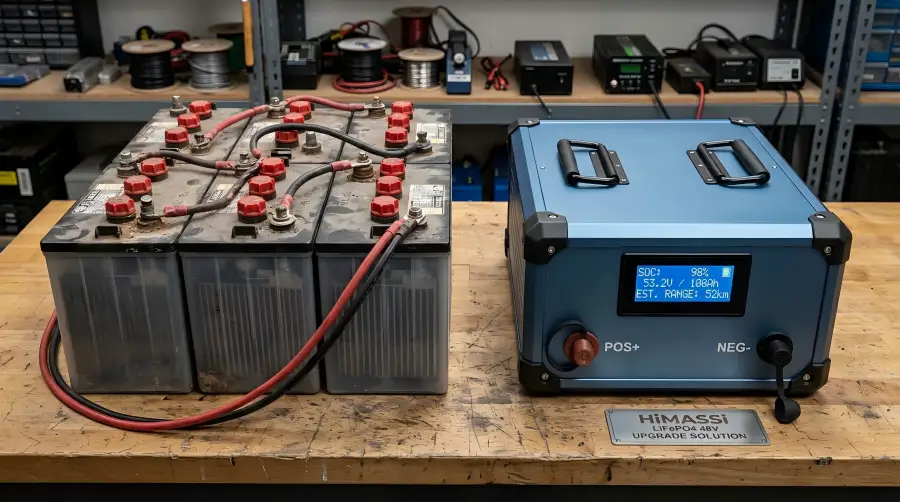
If the golf cart is used infrequently, the existing lead-acid system is in a known condition and routine maintenance is manageable, a like-for-like replacement may be worth comparing. If the vehicle operates frequently every day and reducing watering and routine battery maintenance is a priority, a LiFePO4 solution and its total conversion cost can be assessed.
How Do You Choose the Right Capacity for a 48V Golf Cart Battery?
Compare Energy Before Estimating Driving Range
Amp-hours indicate battery capacity, but when comparing batteries with different voltages, energy should also be calculated:
Nominal Energy (Wh) = Nominal Voltage (V) × Capacity (Ah)
For example, a battery rated at a nominal 51.2V and 100Ah has a nominal energy of 5,120Wh, or 5.12kWh. This is simply an example calculation and does not represent the actual specifications of any particular HiMASSi® product.
Driving range can be estimated using the following relationship:
Estimated Range = Usable Energy ÷ Actual Energy Consumption per Kilometre
For example, if a system is assumed to provide 4.1kWh of usable energy and measured consumption on the same route is 100Wh/km, the estimated range would be approximately 41km. Both the usable energy and energy consumption figures in this example are hypothetical and do not constitute a range guarantee.
A full passenger load, long gradients, frequent starts, low tyre pressure and electrical accessories can all affect real-world results. For this reason, requirements such as “enough for a round of golf” or “enough for a full day” should be translated into measurable factors such as distance travelled, payload and operating hours.
Capacity Is Not the Only Factor — Discharge Capability Also Matters
A higher Ah rating does not necessarily mean a battery can provide a higher continuous current. For vehicles carrying heavier loads or operating on hilly routes, check:
- The battery’s permitted continuous discharge current.
- Peak discharge current and the permitted duration.
- BMS overcurrent protection thresholds.
- Battery-side current requirements of the vehicle controller.
Motor phase current and battery-side current shown in controller specifications should not be treated as interchangeable values. The battery supplier or installer should check the specific controller documentation to avoid comparing values that are defined differently.
What Should You Check When Upgrading a Golf Cart from Lead-Acid to Lithium?
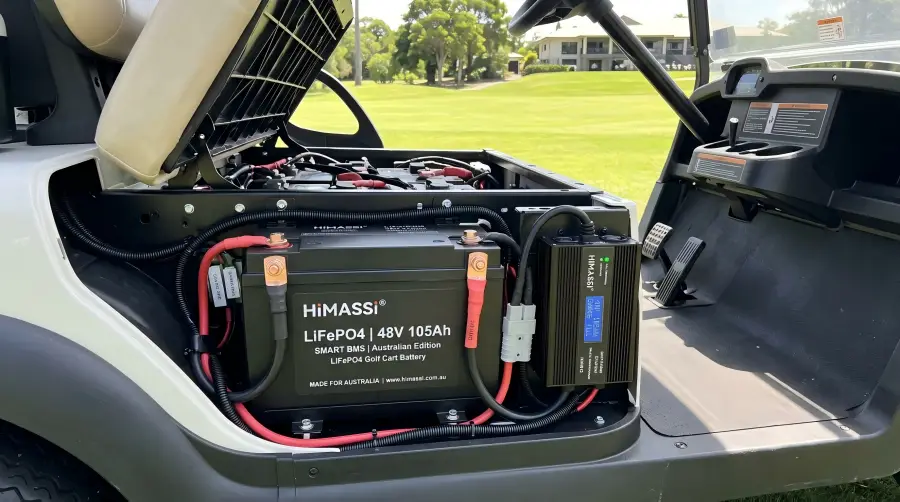
A lithium upgrade involves the complete power system, not just the battery. As manufacturer compatibility information often shows, vehicle compatibility and charger compatibility generally need to be checked separately.
| Upgrade Area | What to Check |
| Charger | Charging voltage, charging profile, current, connector and communication requirements |
| BMS | Continuous output, short-duration output, temperature monitoring and fault protection logic |
| Mounting | Bracket strength, battery restraint, terminal protection and clearance for cable movement |
| Battery gauge | Whether it is compatible with the new battery chemistry and whether replacement or calibration is required |
| Low-voltage accessories | Whether they are powered through a suitable DC-DC converter |
| Vehicle controls | Whether the vehicle uses communication, wake-up signals, interlocks or regenerative braking that may affect compatibility |
Do not assume the original charger can continue to be used simply because the plug fits. Likewise, do not assume multiple lithium battery modules can be connected in series or parallel in any configuration. Always follow the connection arrangements explicitly approved for the specific battery model.
After the conversion is completed, the installer should inspect the mounting and wiring before carrying out charging, start-up, hill-climbing and operating tests under loads close to normal use. Any warning or fault events should also be recorded.
What Costs Should You Compare in Brisbane and Gold Coast Golf Cart Battery Quotes?
When comparing golf cart battery prices, ask suppliers to itemise the following:
| Cost or Term | What to Confirm When Requesting a Quote |
| Battery | Model, quantity, nominal energy and whether GST is included |
| Supporting components | Whether the charger, brackets, cables, battery gauge and converters are included |
| Installation and commissioning | Installation location, vehicle compatibility work and commissioning tasks |
| Delivery | Cost based on the specific postcode and whether special handling is included |
| Old battery disposal | Whether recycling or disposal arrangements are available and how costs are calculated |
| After-sales terms | Warranty period, capacity-related conditions, labour costs and responsibility for freight |
Do not assume stock availability or onsite service coverage based solely on the city name. Different postcodes, vehicle locations and order quantities across Brisbane and the Gold Coast can affect actual delivery arrangements. Written quotations should be used to confirm the final scope and costs.
Frequently Asked Questions About Golf Cart Batteries
Can a 48V Golf Cart Use a 51.2V LiFePO4 Battery?
Some LiFePO4 batteries intended for nominal 48V systems have a nominal voltage of 51.2V. Whether a particular battery is suitable depends on its full-charge voltage, the controller’s permitted voltage range, charger compatibility and the vehicle manufacturer’s requirements. The nominal system name alone is not enough to determine compatibility.
Can a 100Ah Battery Last a Full Day?
It depends on driving distance, payload, gradients, idle time and accessory power consumption. A useful approach is to record the route and charging pattern over a typical working day, then assess the required capacity based on usable energy while allowing some margin for route variations and battery ageing.
If a Golf Cart Is Used Near the Coast on the Gold Coast, Does a Lithium Battery Still Need Corrosion Inspections?
Yes. Battery terminals, cable connections and mounting hardware can still be affected by moisture and salt exposure. Inspection intervals should be based on the actual level of exposure and the battery manufacturer’s maintenance requirements.
If the Battery Cuts Out While Driving Uphill, Does That Mean the Capacity Is Too Low?
Not necessarily. A cut-out may also be caused by overcurrent protection, voltage drop across connections, a low state of charge or temperature protection. Fault records and overall system compatibility should be checked before assuming that installing a battery with a higher Ah rating will resolve the issue.
Can the Original Lead-Acid Charger Be Used with a Lithium Battery?
Only if the battery manufacturer explicitly confirms compatibility and any required settings or upgrades have been completed. A matching connector and similar nominal voltage are not enough to demonstrate that the charging parameters are suitable.
How Should a Golf Cart Battery Be Managed During Long-Term Storage?
Follow the instructions for the specific battery. Lead-acid and LiFePO4 batteries may have different storage state-of-charge and maintenance charging requirements. Standby power consumption from onboard equipment should also be considered. Storage practices for one battery chemistry should not automatically be applied to another.
Is the Warranty Period the Same as the Battery’s Service Life?
No. A warranty defines the supplier’s after-sales obligations under specified conditions, while actual service life is influenced by temperature, cycle intensity, depth of discharge and maintenance. Warranty coverage, capacity-related conditions and associated costs should therefore be reviewed separately.
About HiMASSi®
HiMASSi® is the official flagship brand launched by Shenzhen Himax Electronics Co., Ltd. for the Australian market. We believe battery selection should be based on clearly defined product specifications and real-world operating requirements. If you are sourcing or replacing golf cart batteries in Brisbane or the Gold Coast, you can provide HiMASSi® with your vehicle model, existing battery configuration, charger label and typical usage profile to discuss suitable products and compatibility requirements. Specific product specifications, stock availability, delivery arrangements and warranty terms should be confirmed on the relevant product page and in writing.