
Key Takeaways
- Solar battery capacity should be determined by considering daily energy consumption, critical load power requirements, desired backup duration, and local solar conditions.
- When calculating battery capacity, distinguish between nominal capacityand usable capacity rather than relying only on the kWh rating listed on the product nameplate.
- Grid-connected energy storage, backup power, and off-grid systems require different approaches to battery sizing.
- Battery capacity determines how long a system can provide power, while inverter power determines how many appliances or loads the system can support at the same time.
- Australian homes commonly use 230V single-phase power, while some properties use 230/400V three-phase supply. System designers should consider the property’s electrical configuration as well as the startup power requirements of air conditioners, pumps, and other motor-driven loads.
- Installers should allow reasonable capacity headroom for future load growth, extreme weather, and battery degradation, but should avoid unnecessarily oversizing the system.
- The final system design should also be confirmed based on equipment specifications, site survey results, network requirements, and applicable local electrical and installation requirements.
Introduction
For solar installers, distributors, and system integrators, accurately sizing a solar battery system is one of the most important parts of both project design and the customer sales process. If the battery capacity is too small, the system may not meet the customer’s backup power or nighttime energy needs. If it is too large, it can increase the customer’s upfront investment and extend the payback period.
This guide explains how to calculate solar battery capacity based on customer loads, backup duration, solar generation, battery depth of discharge, and inverter power. It also includes an Australian residential example to help installers and distributors with initial system sizing.
What Is Solar Battery System Capacity?
Solar battery system capacity is typically measured in kilowatt-hours (kWh) and represents the amount of electrical energy a battery can store. For example, a battery system with a nominal capacity of 20 kWh can theoretically store 20 kWh of energy.
In real-world use, however, customers typically cannot use the entire nominal capacity. Allowable depth of discharge, inverter conversion efficiency, wiring losses, ambient temperature, and system reserve settings can all affect the amount of energy that is actually available.
For this reason, installers designing a solar energy storage system should distinguish between the following specifications:
| Parameter | Common Unit | What It Means |
| Battery Nominal Capacity | kWh | Total energy storage capacity specified for the product |
| Battery Usable Capacity | kWh | Energy that can actually be used within the allowable discharge range |
| Battery Output Power | kW | Power the battery can deliver continuously or for short periods |
| Inverter Rated Power | kW | AC power the inverter can continuously supply to loads |
| Solar Array Capacity | kW or kWp | Total rated power of the solar modules under standard test conditions |
| Peak Sun Hours | h/day | Local solar irradiation expressed as the equivalent number of full-power solar generation hours |
How to Calculate Solar Battery System Capacity
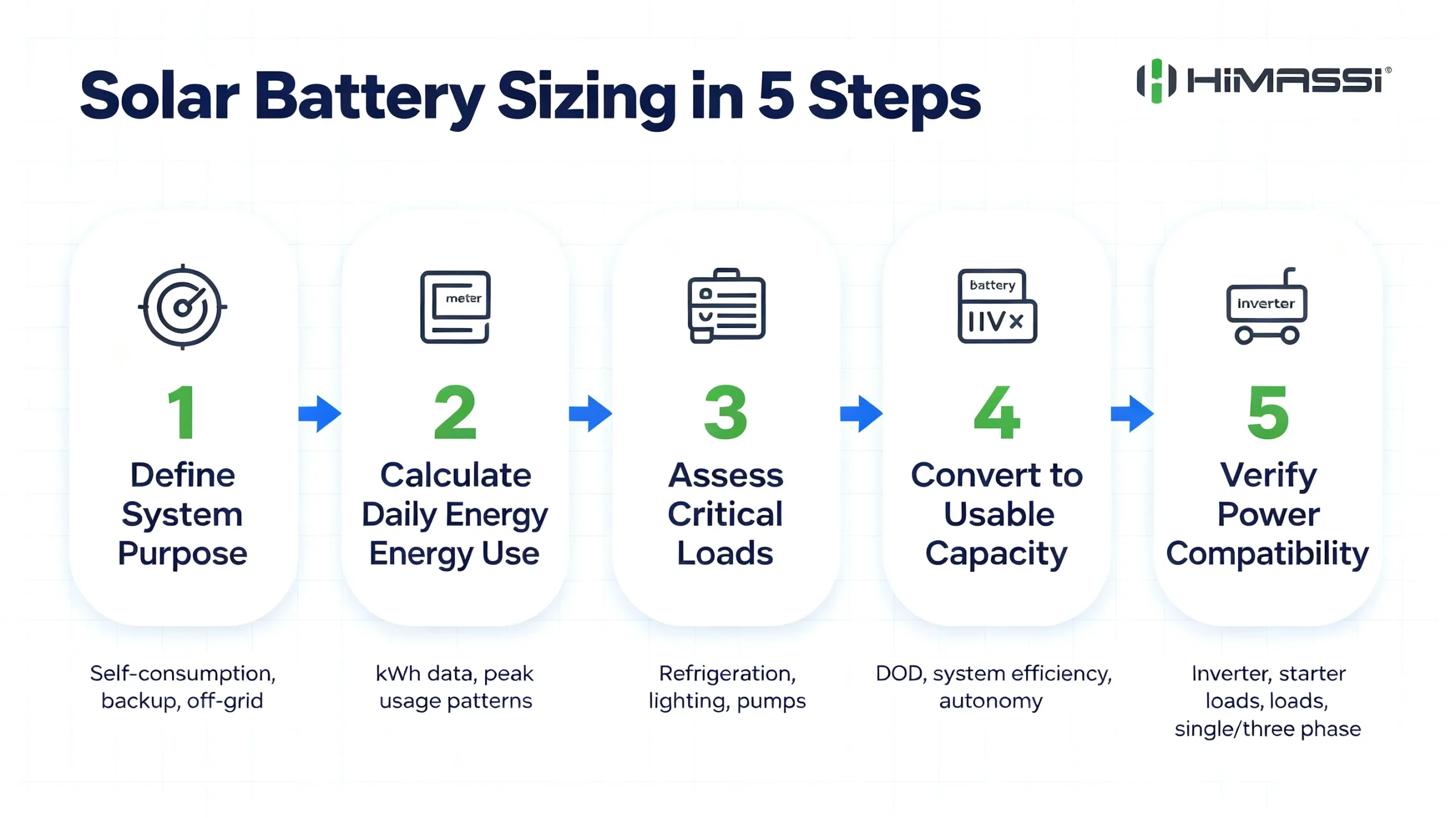
Step 1: Define the Purpose of the System
The first step for installers is to determine the customer’s primary reason for purchasing a battery.
- Reduce peak electricity costs:Charge the battery when electricity rates are lower or when solar generation is abundant, then discharge it during higher-rate periods.
- Increase solar self-consumption:Store unused solar energy generated during the day for use at night.
- Power outage backup:Supply critical equipment when the electricity grid goes down.
- Whole-home backup:Maintain as much normal household operation as possible during a power outage.
- Off-grid power:Rely entirely on solar, batteries, and a backup generator to supply electrical loads.
Different goals require different design standards. A battery intended for short-term emergency backup does not need to cover the customer’s entire daily energy consumption. An off-grid system, however, must account for worst-case seasonal conditions and consecutive days of poor solar generation.
Step 2: Determine Daily Energy Consumption
Start by collecting the customer’s electricity bills from the most recent 12 months and calculating average annual and monthly energy consumption. If interval data from a smart meter is available, installers should further analyse how the customer’s loads vary during the day, at night, and during peak periods.
Average daily energy consumption can be estimated as follows:
Average Daily Energy Consumption (kWh) = Monthly Energy Consumption (kWh) ÷ Number of Days in the Month
For example, if an Australian home consumes 900 kWh per month, assuming a 30-day month:
900 ÷ 30 = 30 kWh/day
If the customer only wants to power critical loads during an outage, those critical appliances should be calculated separately instead of using the home’s total average daily energy consumption.
Step 3: Calculate the Energy Required for Critical Loads
The basic formula for calculating critical-load energy requirements is:
Required Usable Energy (kWh) = Load Power (kW) × Operating Time (h)
Suppose a customer wants the following equipment to continue operating after a power outage:
| Equipment | Average Operating Power | Daily Operating Time | Estimated Energy Consumption |
| Refrigerator | 0.15 kW | 10 equivalent operating hours | 1.5 kWh |
| Lighting | 0.30 kW | 5 hours | 1.5 kWh |
| Wi-Fi and Communication Equipment | 0.05 kW | 12 hours | 0.6 kWh |
| TV and Computers | 0.30 kW | 4 hours | 1.2 kWh |
| Heating or Ventilation Equipment | 0.50 kW | 4 hours | 2.0 kWh |
| Other General-Purpose Loads | — | — | 1.2 kWh |
| Total | — | — | 8.0 kWh |
If the customer wants these critical loads to operate for two days without considering solar recharging during that period, approximately 16 kWh of usable energy would be required.
Step 4: Convert Usable Energy to Nominal Battery Capacity
Nominal battery capacity can be estimated using the following formula:
Nominal Battery Capacity = Daily Load Energy × Backup Days ÷ Depth of Discharge ÷ System Efficiency
Assume:
- Daily critical-load energy consumption: 8 kWh
- Backup duration: 2 days
- Allowable depth of discharge: 90%
- Overall battery-to-AC-load efficiency: 90%
The calculation is:
8 × 2 ÷ 0.90 ÷ 0.90 ≈ 19.75 kWh
Therefore, the customer could initially consider a battery system of approximately 20 kWh.
If extended outages are a concern in the area or the customer expects to add more loads in the future, additional capacity can be considered.
Step 5: Check Instantaneous Power and Startup Power
Having enough battery capacity does not necessarily mean the system can operate every appliance.
Installers also need to verify the continuous output power, peak output power, and peak-power duration of both the battery and inverter.
For example, an air conditioner may require only around 3 kW during normal operation, but the compressor can create an instantaneous power demand significantly higher than its normal operating power when it starts. Water pumps, pool pumps, freezers, and other motor-driven equipment may have similar characteristics.
Therefore, installers should check:
- Maximum simultaneous load
- Startup power of individual appliances
- Maximum continuous battery discharge power
- Allowable peak battery discharge power and duration
- Inverter continuous output and surge output capability
- Whether the property uses single-phase or three-phase power
- How loads are distributed across phases in a three-phase installation
- Whether high-power appliances can operate properly in backup mode
For Australian residential projects, installers should also confirm that the battery and inverter configuration is compatible with the property’s electrical supply, whether single-phase or three-phase, and that backup switching equipment, the switchboard, circuits, and protected backup loads are appropriately designed for the project.
Example: What Size Battery Should Be Paired With a 10 kW Solar System in Australia?
Basic Project Parameters
- Project location: Australia
- Residential electrical supply: 230V single-phase
- Solar array capacity: 10 kW
- Average monthly household energy consumption: 900 kWh
- Average daily energy consumption: approximately 30 kWh
- Percentage of energy consumed at night: approximately 55%
- Average nighttime energy demand: approximately 16.5 kWh
- Reference peak sun hours for system design: 5 hours/day
- Overall solar system efficiency: 80%
- Customer goal: increase solar self-consumption and support critical loads during outages
- Daily critical-load energy consumption: approximately 10 kWh
- Target backup duration: 24 hours
- Allowable battery depth of discharge: 90%
- Overall battery-to-AC efficiency: 90%
Estimate Daily Solar Generation
Daily Solar Generation = Solar Capacity × Peak Sun Hours × System Efficiency
10 kW × 5 h × 0.8 = 40 kWh/day
Under favourable weather conditions with no significant shading, the system could generate approximately 40 kWh per day.
Actual solar production, however, can be affected by location, seasonality, module temperature, dust and soiling, array orientation, tilt angle, shading, weather conditions, and network export limitations.
Calculate Battery Capacity Based on Nighttime Energy Consumption
Nominal Battery Capacity = 16.5 ÷ 0.90 ÷ 0.90 ≈ 20.37 kWh
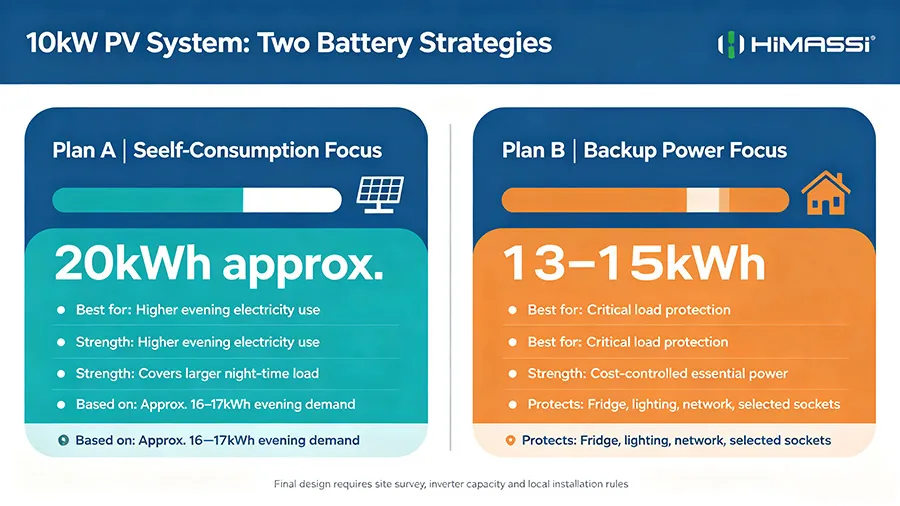
If the primary goal is to shift excess daytime solar energy to nighttime use, a battery system of approximately 20 kWh could be considered as an initial option.
Calculate Battery Capacity Based on Critical-Load Backup
Nominal Battery Capacity = 10 ÷ 0.90 ÷ 0.90 ≈ 12.35 kWh
If the customer’s primary goal is to keep the refrigerator, lighting, internet, selected power points, and other essential household loads operating for 24 hours during an outage, approximately 13–15 kWh may be sufficient for the initial system design.
After considering both nighttime consumption and backup requirements, the distributor could offer the customer two options:
| Option | Recommended Battery Capacity | Best For | Key Features |
| Basic Backup Option | Approx. 15 kWh | Critical-load backup | Lower upfront investment; not recommended for extended operation of high-power air conditioning |
| Enhanced Energy Storage Option | Approx. 20–25 kWh | Increasing solar self-consumption and improving backup capability | Covers more nighttime loads while providing additional capacity headroom |
If the customer wants to continue operating air conditioning during a power outage, the system should be recalculated based on the air conditioner’s actual operating power, startup current, and desired runtime.
Installers should also confirm that the inverter and battery have sufficient continuous and peak output power.
How Does Solar Array Size Affect Battery Selection?
The battery needs enough capacity to store energy, but the solar array must also be capable of supplying daytime loads while providing enough excess energy to recharge the battery.
Daily solar generation can be estimated using the following formula:
Daily Solar Generation (kWh) = Solar Capacity (kW) × Peak Sun Hours (h) × Overall System Efficiency
Suppose an 8 kW solar system is installed in an area with 4.5 peak sun hours, and overall system efficiency is estimated at 80%:
8 × 4.5 × 0.8 = 28.8 kWh/day
If the customer directly consumes 18 kWh during the day, theoretically only about 10.8 kWh remains available for battery charging.
In this situation, even if a 30 kWh battery is installed, the solar system may not be able to fully charge it within a single day.
Therefore, solar battery capacity should always be evaluated together with:
- How much energy the solar system is expected to generate each day
- How much solar energy will be directly consumed by daytime loads
- Whether the grid-connected system allows the battery to charge from the electricity grid
- Whether the customer uses time-of-use electricity tariffs
- Whether solar production drops significantly during winter or periods of poor weather
- Whether the solar system can continue operating and recharge the battery during a power outage
Key Variables That Affect Solar Battery Capacity
| Variable | Impact on Capacity Design | Recommendation for Installers |
| Daily Energy Consumption | Higher energy consumption generally requires more battery capacity | Obtain at least 12 months of electricity usage data |
| Nighttime Energy Consumption | Higher nighttime loads increase energy storage requirements | Analyse smart meter load profiles where available |
| Backup Duration | Longer backup periods require more battery capacity | Determine which loads the customer is willing to shed |
| Depth of Discharge | A lower allowable discharge percentage requires greater nominal capacity | Use the manufacturer’s specified usable capacity |
| System Efficiency | Greater conversion losses require more capacity headroom | Account for inverter, wiring, and standby losses |
| Peak Power | Determines whether the battery and inverter can operate the required equipment | Check both continuous and surge power |
| Local Solar Conditions | Determine how quickly solar can recharge the battery | Use reliable local solar irradiation data |
| Ambient Temperature | May affect battery performance and service life | Plan the installation location according to the product’s allowable temperature range |
| Future Loads | EVs, heat pumps, and other equipment can increase demand | Consider battery systems that support modular expansion |
| Local Requirements | Affect equipment, wiring, installation, grid connection, and approvals | Ensure the system is designed and installed by appropriately qualified professionals |
How Do Capacity Requirements Differ for Grid-Connected, Backup, and Off-Grid Systems?
Grid-Connected Energy Storage Systems
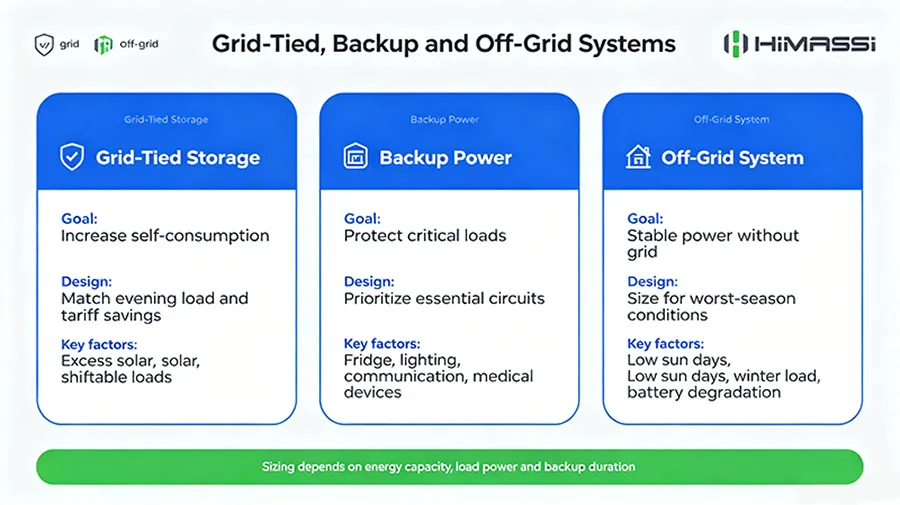
The primary goals of grid-connected energy storage are typically to increase solar self-consumption or manage time-of-use electricity tariffs.
Installers should analyse the customer’s daily load profile and calculate the amount of excess solar energy available during the day, as well as the loads that can be shifted to nighttime.
If the electricity grid is reliable, the customer does not necessarily need enough battery capacity to cover the home’s entire daily energy consumption.
An oversized battery that cannot be sufficiently charged and discharged during normal daily operation may reduce the economic value of the project.
Backup Power Systems
For backup systems, critical and non-critical loads should be separated first.
Refrigerators, lighting, communication equipment, essential medical equipment, and selected power circuits are typically higher-priority loads. High-power appliances such as electric water heaters, clothes dryers, pool heating equipment, and some large air-conditioning systems may be temporarily turned off during an outage.
Using dedicated backup circuits or smart load management can extend backup duration without unnecessarily increasing battery capacity.
Off-Grid Solar Systems
Off-grid systems do not have the electricity grid available as a backup, so system design must be more conservative.
In addition to normal daily energy consumption, installers should consider:
- Solar irradiation during the worst month of the year
- Consecutive days of poor solar generation
- Minimum battery reserve level
- Winter heating or summer cooling requirements
- The solar array’s ability to supply loads while recharging the battery
- Backup generator power and fuel availability
- Battery capacity degradation after long-term cycling
Off-grid systems should not be designed solely around annual average solar conditions. Particular attention should be given to the most challenging seasonal conditions at the project location.
Common Battery Sizing Mistakes for Installers and Distributors
Mistake 1: Looking Only at the Customer’s Average Electricity Bill
The dollar amount of an electricity bill is affected by electricity tariffs, supply charges, time-of-use pricing, and other fees, so it does not directly represent actual energy consumption.
Installers should use the customer’s kWh usage data from the bill and obtain detailed load profiles whenever possible.
Mistake 2: Treating Nominal Capacity as Usable Capacity
A battery rated at 20 kWh does not necessarily deliver 20 kWh to AC loads.
Allowable depth of discharge, inverter efficiency, and required system reserves should all be considered.
Mistake 3: Calculating kWh but Ignoring kW
Even a battery with a large energy capacity may be unable to start or continuously operate an air conditioner, water pump, pool pump, or other high-power equipment if its output power is insufficient.
Mistake 4: Ignoring Solar Recharging Capability
A large battery paired with insufficient excess solar generation may remain partially charged for extended periods.
Solar array capacity, battery capacity, and load requirements should always be evaluated together.
Mistake 5: Using the Same Sizing Ratio for Every Customer
Homes, retail stores, farms, warehouses, and off-grid properties can have very different load characteristics.
Standardised product packages can improve quoting efficiency, but final battery capacity should still be adjusted based on project-specific data.
Solar Battery System Sizing FAQ
- How Many kWh of Solar Battery Capacity Does a Typical Australian Home Need?
Household energy consumption varies significantly, so battery capacity cannot be determined based on the idea of a “typical Australian home” alone.
A smaller critical-load backup system may start at around 10 kWh. Homes that need to cover more nighttime energy use or longer power outages may require 20–40 kWh or more.
Electric vehicles, air conditioning, electric hot water systems, pool pumps, heating systems, and other high-power appliances can significantly affect the final battery size.
- Can Solar Panels Recharge a Battery During a Power Outage?
It depends on the system architecture, inverter capabilities, backup configuration, and electrical design.
A standard grid-connected solar system will generally stop supplying power when the electricity grid goes down as part of its required grid-protection functions.
A properly configured solar-plus-storage system with backup capability may be able to establish a controlled backup supply during an outage and continue using available solar energy to recharge the battery.
- How Should Battery Capacity and Inverter Power Be Matched?
Battery capacity determines how long the system can provide power, while inverter power determines how much load the system can support at the same time.
System selection should be based on the maximum simultaneous load and maximum startup power.
Installers should also verify that the battery’s continuous discharge power and peak discharge capability are compatible with the inverter’s requirements.
- How Much Extra Battery Capacity Should Be Included in the Design?
The amount of additional capacity should depend on the goals of the project.
Future load additions, extreme weather, equipment ageing, battery degradation, and changes in customer usage patterns should all be considered.
Rather than installing an excessively large battery system from the beginning, choosing a battery system that supports modular expansion can often provide greater flexibility.
- How Can Solar Battery Backup Time Be Extended?
Backup time can be extended by increasing battery capacity.
It can also be improved through critical-load prioritisation, smart load management, reducing air-conditioning demand, temporarily turning off high-power electric appliances, and using available solar power directly during daylight hours.
Solar Battery System Sizing Checklist
Before submitting a proposal or quote to a customer, installers and distributors should confirm that:
- At least 12 months of customer energy consumption data has been collected.
- Daytime, nighttime, and peak-period loads have been evaluated.
- Critical and non-critical loads have been identified.
- The customer’s required backup duration has been confirmed.
- Both nominal and usable battery capacity have been calculated.
- Continuous power and appliance startup power have been verified.
- Daily solar generation and available excess solar energy have been evaluated.
- Seasonal conditions, periods of poor weather, and high temperatures have been considered.
- Compatibility among solar modules, batteries, inverters, and control equipment has been confirmed.
- Single-phase or three-phase supply requirements have been considered.
- Future loads such as electric vehicles, electric hot water systems, heat pumps, and additional air conditioning have been considered.
- Applicable electrical, grid-connection, installation, and local approval requirements have been reviewed.
- The assumptions used to estimate solar generation and backup duration have been clearly explained to the customer.
Try HiMASSi® Battery Solution
Sizing a solar battery system is not as simple as applying a fixed ratio between solar array power and battery capacity. It requires a comprehensive evaluation of the customer’s actual energy consumption, nighttime loads, required backup duration, local solar conditions, solar recharging capability, and the continuous and peak power requirements of the equipment.
HiMASSi® is the official flagship brand of Shenzhen Himassi Electronics Co., Ltd. in Australia and is positioned as one of Australia’s leading battery manufacturers. HiMASSi® focuses on solar energy storage battery solutions for installers, distributors, and system integrators, with battery products designed for residential, commercial and industrial, and off-grid applications.
With modular designs and flexible capacity configurations, HiMASSi® battery solutions can help partners plan energy storage systems around different Australian project requirements while providing flexibility for future capacity expansion.